
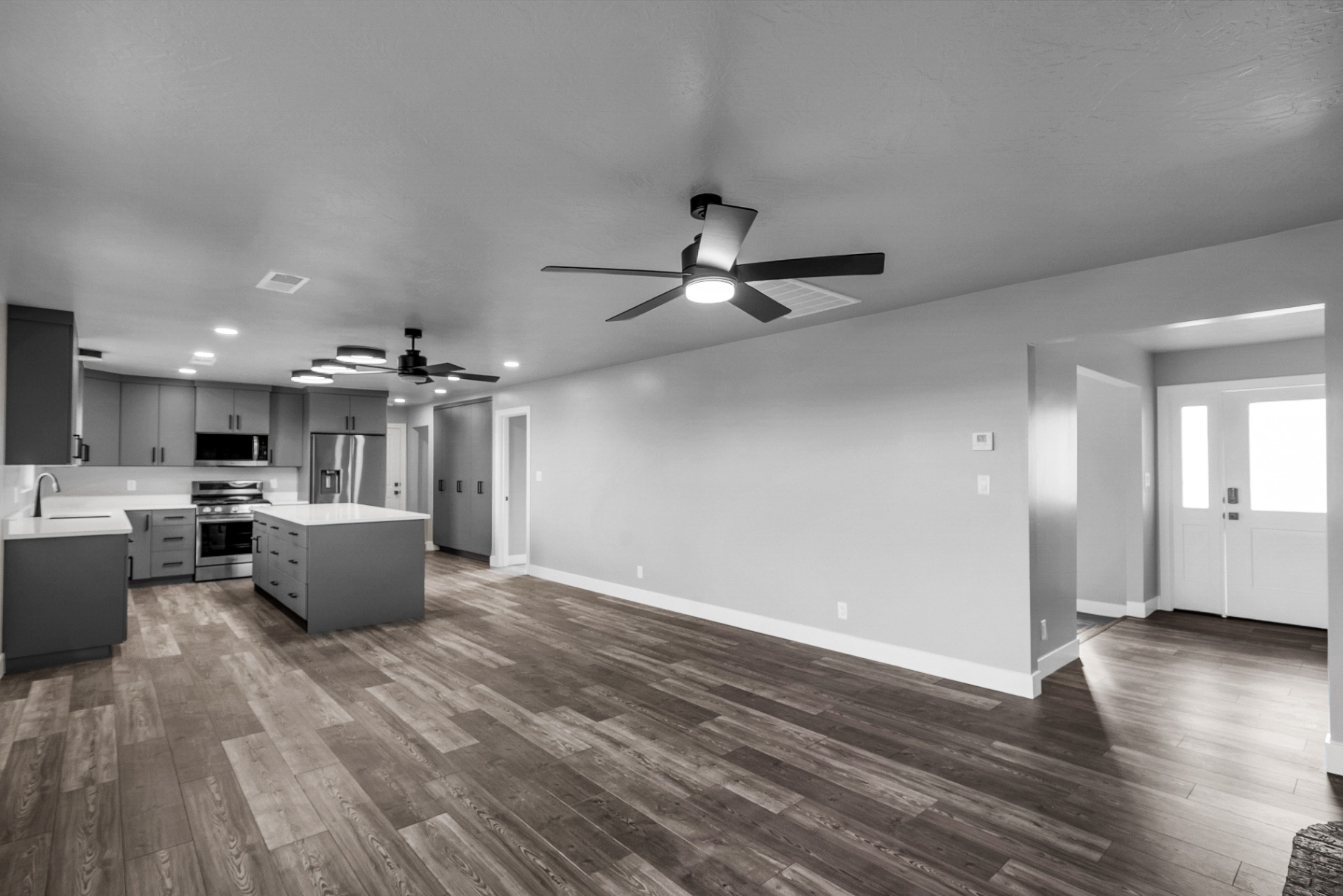
Solid Surface vs. Quartz Countertops: How to Choose

Quartz is the better pick when you want a stone look and the toughest everyday surface. Solid surface, the category Corian belongs to, is the better pick when you want seamless runs, curves, an integrated sink or a top you can sand back to new. Cost won’t settle it: published installed prices for the two overlap heavily. What settles it is how you cook, how you clean and what shape your kitchen is. Because the countertop is one decision inside a larger remodel, it also helps to see the material in your own layout before you commit. Our design team does that with 3D renderings and virtual consultations.
TL;DR
- Quartz is about 95% ground natural quartz and 5% resin (The Spruce). It resists stains, scratches and heat better, and it looks like stone.
- Solid surface is mineral filler in acrylic or polyester resin. It has nearly invisible seams, can be shaped into curves, and scratches or scorch marks can be sanded out.
- Both are non-porous and never need sealing.
- Price ranges overlap. Bob Vila lists quartz at $65 to $270 and solid surface at $60 to $275 per installed square foot, so your color, edge and layout move the price more than the material name.
- Rule of thumb: a busy family kitchen with lots of hot pans and knives leans quartz. A seamless, curved or repairable surface, such as a bathroom vanity top with an integral sink, leans solid surface.
Table of Contents
- What each material actually is
- Look and feel
- Seams: where solid surface pulls ahead
- Scratches, stains and heat
- Weight, durability and lifespan
- What each costs installed
- Which one fits which room
- See it in your kitchen before you buy
- Our point of view
- FAQ
- Sources
What each material actually is
Solid surface is a manufactured sheet of mineral dust, mostly marble, mixed with plastic resins and pigments. DuPont introduced it in 1967 under the name Corian, and other brands such as Avonite and Swanstone followed (The Spruce). Many people say “Corian” for the whole category, much as they say “Kleenex” for tissues. So when you see “Corian vs. quartz,” you are really comparing solid surface to quartz.
Quartz, often called engineered stone, is newer. It is roughly 95% ground natural quartz bound with about 5% resin, pressed into slabs. HGTV puts the proportions of solid surface at about a third synthetic polymer and two thirds natural material (HGTV), which shows why the two behave so differently. Quartz is mostly rock, so it feels and acts like stone. Solid surface is mostly resin-bound mineral, so it behaves more like a dense, workable solid.
Both sit in the middle of the market: a step above laminate, wood and tile, and a step below premium natural stone.
Look and feel
Quartz is the stone-look material. Its patterns are designed to imitate marble, granite and concrete, and it is about 33% heavier than solid surface, which gives an installed top a more substantial feel (The Spruce). Some patterns can look unnaturally uniform, according to Consumer Reports’ countertop buying guide, so look at a full slab, not only a small sample chip.
Solid surface reads as smooth and uniform. The color runs all the way through the thickness, so it can be cut, routed and shaped without exposing a different layer. That is why it suits contemporary kitchens, curved bar tops and wraparound details, and why it can be thermoformed into flowing shapes that quartz cannot match. Bob Vila notes that solid surface had its heyday in the 1990s and early 2000s but remains popular for its consistent look, color variety and ability to mimic natural stone, and that kitchen and bath designers like its seamless appearance and repairability.
If you are still weighing a bold stone pattern against a calm, quiet surface, make that decision with your cabinet color and flooring in view. A material that looks great in a showroom can fight with a busy backsplash at home.

Seams: where solid surface pulls ahead
Every countertop longer than a slab has a seam somewhere. The difference is how it looks.
- Solid surface pieces are joined with a bonding adhesive in a matching color, and the joint is nearly invisible once sanded.
- Quartz seams are filled and visible, though not prominent. The Spruce rates the degree of visibility as roughly equal on a well-made job, and the real result depends heavily on the fabricator.
Seams matter most on long runs, L-shaped kitchens and islands. They also matter around sinks. Solid surface can be made with an integral sink molded into the top, so there is no rim or crevice where grime collects. If you are planning a larger island, our guide to kitchen island size, clearances and seating shows how dimensions affect where seams fall.
Scratches, stains and heat
This is where the two materials differ most day to day.
| Everyday test | Quartz | Solid surface |
|---|---|---|
| Stains | Non-porous, no sealing needed | Non-porous, no sealing needed |
| Knives and scratches | Scratch resistant, not scratch-proof | Cutting on it will scratch it |
| Fixing scratches | Hairline marks buff out; deeper ones need a technician | Homeowner can sand and buff fine scratches |
| Hot pans | Higher heat resistance, but a hot pan should still go on a trivet | Scorching can happen, and can be sanded out |
| Chips | Edges and corners can chip, and repair is a pro job | Dents and chips can be repaired in place |
| Sunlight | Can fade under direct sun, so poor for outdoor use | Best kept indoors |
Sources: The Spruce, Consumer Reports and Bob Vila.
In Consumer Reports’ lab tests, quartz survived spills, hot pots and knives with top scores, while solid surfacing resisted heat and impacts but scratched and cut easily. Bob Vila’s interior designer source adds that quartz with a resin content of 7 percent or less is less likely to discolor from heat, though a hot pan should not go directly on it.
The practical reading: quartz holds its finish with less attention. Solid surface asks you to use a cutting board, but it forgives you, because the damage is usually repairable at home. Consumer Reports’ cleaning guidance says fine scratches on solid surface come out with a mild abrasive or fine-grit sandpaper, while glossy finishes and deep cuts are best left to a professional.
Maintenance in plain terms
Quartz needs soap, water and a soft cloth. Solid surface needs the same, plus an occasional light buffing if you want to erase the marks that daily use leaves. Neither needs sealer, which is the main reason homeowners move away from natural stone.
Weight, durability and lifespan
At 12 mm, solid surface weighs about 4.4 pounds per square foot, versus about 6.2 for quartz (The Spruce). On a standard kitchen with sturdy cabinets that gap rarely matters. It matters more on a second-story addition, a floating vanity or an older cabinet box, where your builder will check the support before the top goes on.

Bob Vila estimates longevity at 30 to 100 years for quartz and 20 to 30 years for solid surface. Treat those as ranges that depend on use and care, not guarantees. Solid surface can be renewed by sanding, which extends its working life in a way quartz cannot match.
What each costs installed
Published figures vary by source and year, which is exactly why you should treat them as ranges:
| Source | Quartz | Solid surface |
|---|---|---|
| Bob Vila, 2025 | $65 to $270 per installed sq ft | $60 to $275 per installed sq ft |
| Bob Vila Corian vs. quartz, 2022 | $50 to $100 per installed sq ft | $50 to $100 per installed sq ft |
| SoFi, 2025 | $50 to $200 per sq ft, plus $60 or more per sq ft for installation | $20 to $80 per sq ft (Angi estimate) |
The Spruce gives a useful raw-material picture: a 30-square-foot sheet of Corian runs about $1,100 to $1,200, while 30 square feet of quartz is $1,500 to $4,500.
So is solid surface cheaper? Often, on material, especially in plain colors. But the ranges overlap so much that edge profiles, color tier, sink cutouts, seam count and demolition of the old top can flip the result. Get your quote based on your actual layout, not a per-foot average. Bob Vila also notes that popular colors cost more.
The countertop is also only one line in a remodel. If you want to see where it sits in the full picture, our kitchen remodel budget breakdown walks through a $40,000 project, and what the most expensive part of a kitchen remodel is helps you decide where to spend and where to save. If your sink or faucet is changing with the top, plan for it early too; typical faucet replacement costs are worth adding to the budget.
Which one fits which room
Choose quartz if:
- You cook a lot and want a hard, low-attention surface.
- You like a marble or granite look without sealing.
- Resale matters. The Spruce notes quartz carries stronger resale value with homebuyers.
- The top will be an indoor kitchen perimeter or island.
Choose solid surface if:
- You want a seamless look across a long run or an L-shape.
- You want an integral sink, a curved edge or a coved backsplash.
- You like the idea of sanding out scratches yourself.
- You are finishing a bathroom vanity, where heat and knives are not a concern.
Solid surface also works beyond the vanity. Because it can be joined seamlessly, it is a common choice for tub and shower surrounds, which we cover in our guide to solid surface shower walls.
Utah considerations
In southwest Utah, strong sun comes through large windows and sliding doors. Quartz can fade under direct sunlight, so for a sun-drenched kitchen with a big west-facing window, or any outdoor kitchen, think carefully about where the material sits and whether a shaded layout works. Dry-climate homes also tend to have plenty of dust, which both materials wipe clean, but fine scratches show more on dark, glossy solid surface than on light matte ones.
See it in your kitchen before you buy
Samples show color. They do not show how a seam lines up with your sink, or how a light quartz pattern reads against your cabinets at 6 p.m. That is where design tools earn their keep. We use virtual consultations and 3D renderings so you can see the layout and finishes together before construction begins, with one point of contact for both design and construction.
If you are comparing countertop options as part of a bigger plan, three offers are relevant. Our kitchen remodeling work includes small kitchen remodels at $20,000 to $40,000 and mid-range remodels at $40,000 to $70,000. If you are enlarging the room, room additions lists kitchen expansions at $50,000 to $150,000. And our bathroom remodeling page covers small bathrooms at $10,000 to $15,000.
We build and remodel across Washington and Iron Counties in Utah. If you are choosing between solid surface and quartz for a project there, tell us about your kitchen and we will walk you through it.
Timing is part of the choice, too. Countertops are templated after cabinets are in, so ordering decisions come early. Our kitchen remodel timeline lays out what to order first, and how long a kitchen remodel takes gives realistic ranges.
Our point of view
Most countertop arguments miss the point. People ask which material is better, when the better question is which one suits the way the room is used. We start with the kitchen: who cooks, how many people are in it at once, how much light comes in and how long the runs are.
When a client wants a calm, stone-look surface that takes care of itself, we steer them toward quartz. When they want a seamless run, a curved peninsula or an integrated sink, solid surface is the material that does it properly. Neither is a compromise. Each is the right answer to a different kitchen.
That is why we like to show the finished room in a 3D rendering before anyone orders a slab. Seeing the seam, the edge and the color against the cabinets turns a guess into a decision, and it keeps design and construction in one conversation with one point of contact.
Jake
FAQ
Is Corian the same as solid surface?
Corian is a brand of solid surface, the first one, introduced by DuPont in 1967. Other brands include Avonite and Swanstone. Because Corian was first, many people use its name for the whole category, so “Corian vs. quartz” and “solid surface vs. quartz” are the same comparison.
Why did solid surface go out of style?
It was at its most popular in the 1990s and early 2000s, and stone-look quartz has since dominated the market. Solid surface is still chosen for its seamless appearance, color range and repairability (Bob Vila). Designers still reach for it when a project needs curves, integral sinks or invisible joints.
Which is more durable, quartz or solid surface?
Quartz is harder and handles heat, knives and spills better, which is why it earned top scores in Consumer Reports’ lab tests. Solid surface scratches more easily, but its damage is usually repairable by sanding. Which is more durable in your home depends on whether you value resistance or repairability.
Do quartz or solid surface countertops need sealing?
Neither. Both are non-porous, so you do not need to seal them as you would some natural stones. Regular cleaning with mild soap and water is enough for daily care.
Is quartz or solid surface cheaper?
Solid surface is often cheaper in raw material, but published installed ranges overlap heavily. Color, edge profile, seam count, sink cutouts and removal of the old top change the total more than the material name does. A quote for your actual layout is the only reliable number.
Sources
- Solid Surface Countertops vs. Quartz Countertops, The Spruce
- Quartz vs. Corian: Pros and Cons, HGTV
- Best Countertop Buying Guide, Consumer Reports
- The Best Countertop Materials for Every Type of Kitchen, Bob Vila
- Corian vs. Quartz Countertops: What’s the Difference?, Bob Vila
- Cost of Countertops & Installation, SoFi
Recommended
Images in this article are editorial illustrations, not Prestigious project photography.