
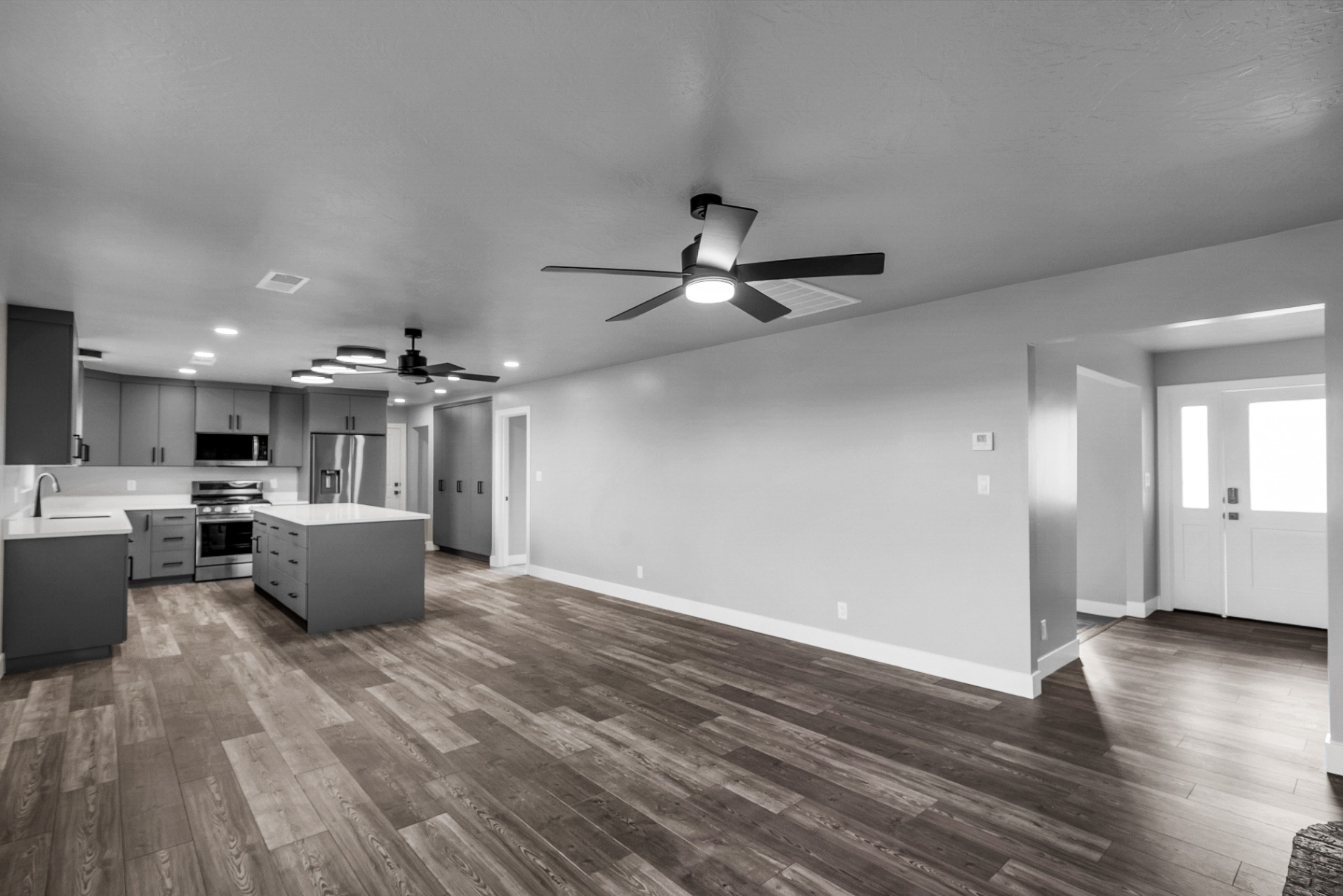
Stained vs Painted Cabinets: How to Choose for Your Kitchen

Choose paint if you want a specific color, a smooth uniform look, or cabinets built from MDF or maple. Choose stain if you have attractive solid wood and want the grain to show. Neither finish is better in every kitchen. The right one depends on your cabinet material, your budget and how you want the room to feel.
This guide covers how each finish looks, which woods suit which, how they wear, what they cost, and how the finish question connects to the bigger one: reface your cabinets or replace them.
TL;DR
- Stain is translucent and shows the wood grain. Paint is opaque and gives you almost any color with a uniform surface.
- Paint suits smooth, grain-free materials such as MDF and maple. Stain suits woods with character, such as oak, cherry and walnut.
- Both finishes need a protective topcoat to survive a working kitchen. Paint tends to show chips at edges and hinges, while stain tends to look worn more gradually.
- Refacing makes sense when your cabinet boxes are sound and your layout works. If the boxes are damaged or the layout is wrong, replacement is the better use of money.
- Finish is only one line of the budget. Door style, wood species and construction usually move the price more.
Table of Contents
- How stained and painted cabinets look different
- Which woods and materials suit paint or stain
- Durability, upkeep and repairs
- What painted and stained cabinets cost
- Cabinet refacing vs replacement
- Perspective
- How to decide: a short checklist
- Plan your cabinet finish with Prestigious Home Builders
- FAQ
- Sources
How stained and painted cabinets look different
Stain soaks into the surface of the wood. It tints the grain without hiding it, so knots, swirls and color variation stay visible. Each door looks a little different, which is the appeal. Stained cabinets read as warm, natural and traditional, though a gray or espresso stain can look quite modern.
Paint sits on top of the surface. It forms an opaque film that hides the grain completely and gives a consistent, even color door after door. The Des Laurier guide to painted and stained cabinet cost makes the same basic distinction. It is why paint is the natural choice when color is the point of the room: soft white, deep green, navy, greige.
A quick way to decide on looks:
- You want to see wood: stain.
- You want a clean, flat color and a more designed look: paint.
- You want a two-tone kitchen: paint the perimeter cabinets and stain an island, or the reverse. The contrast adds depth and is easy to carry out in new construction.
- You are unsure about trends: pick the finish that fits the architecture of your home and your hardware, countertops and flooring. A finish chosen to match its surroundings ages better than one chosen from a trending list.
Color decisions rarely stop at the kitchen. If you are weighing bold against neutral across the house, the same thinking applies to exterior details, as in this comparison of white vs black window frames. A translucent finish lets the material speak, and an opaque one lets the color speak.
Which woods and materials suit paint or stain
The material decides more than most homeowners expect.
For paint: you want a smooth, closed surface. Maple is widely considered the best solid wood for painted cabinets because its grain is tight. MDF panels are another common choice for painted doors because they have no knots or open grain, as the Des Laurier paint-grade guide explains. Open-grained woods such as oak can be painted, but the grain texture will telegraph through unless it is filled first.
For stain: you want wood worth looking at. Oak, cherry, walnut, hickory and rift-cut white oak all take stain well and show their character. Birch and maple can be stained too, but they can look blotchy without careful preparation, so they are often painted instead.

For existing cabinets: what you already have narrows the field. Solid oak doors in good shape can be refinished either way. Thermofoil or laminate doors are a different matter, because neither finish bonds reliably to them without replacement doors.
A useful rule: pick the finish after you pick the material, not before. If you are building a new kitchen, ask your builder which species and door construction they would pair with the finish you love. That conversation saves more money than any finish upgrade.
Durability, upkeep and repairs
Both finishes are only as good as the protective coat and the way it was applied.
Stain needs a clear topcoat. Stain provides color, and a clear coat such as varnish, lacquer or polyurethane provides wear protection. Wood expands and contracts with seasonal humidity, and because stain soaks into the wood rather than forming a thick film, it tends to move with it. Wear usually shows up as dulling around handles and near the sink, where oils and moisture collect. Touch-ups can blend in, since the grain disguises small repairs.
Paint forms a film. That film resists moisture and wipes clean easily, which is why a painted kitchen can look crisp for years. The tradeoff is that a rigid film can chip at edges, hinges and hardware, and hairline cracks can appear at the joints where door frame pieces meet, because the wood underneath moves. A good factory or professional spray finish handles this far better than a brushed-on one, and prep quality matters as much as the paint itself.
Repairs differ. A chip in a painted door needs matching paint and a steady hand, and over time the touch-ups may show against the older finish. Many painted kitchens are eventually repainted as a whole. Stained wood can often be refreshed with a light restoration, but it is very hard to go from paint back to stain, so choose with that one-way street in mind.
Cleaning is similar. Use a soft cloth, mild soap and water, and dry the surface. Avoid abrasive pads and harsh solvents on either one. Wipe up spills around the sink and dishwasher quickly, since standing moisture is the common enemy of every cabinet finish.

What painted and stained cabinets cost
Finish cost depends on where you start. Refinishing existing cabinets costs a fraction of building a new kitchen, while a new kitchen’s cost is driven mainly by cabinet grade and species. Stock and semi-custom cabinets generally run between roughly $100 and $400 per linear foot installed, according to this wood type and cost guide. Birch, red oak and paint-grade maple sit at the lower end. Cherry, walnut and rift-cut white oak sit at the top. On a 25-linear-foot kitchen, that spread runs from around $2,500 for budget birch to well over $10,000 for premium walnut.
Two things to keep in mind when you compare quotes:
- Painted is not automatically the cheaper finish, or the more expensive. Painting needs more preparation steps (sanding, filling, priming, multiple coats), which adds labor. Stain on premium species adds material cost. Ask for each option priced on the same doors.
- The finish is a small part of a remodel. Door style, drawer construction, hardware and layout changes outweigh it. For a sense of where cabinet dollars land in a full project, see our kitchen remodel budget breakdown and our look at the most expensive part of a kitchen remodel.
For context on the whole project, our small kitchen remodels run $20,000 to $40,000 and mid-range remodels run $40,000 to $70,000. Cabinet finish decisions fit inside those ranges. Luxury kitchen remodels are quoted individually.
Cabinet refacing vs replacement
The finish question often turns into a bigger one: is it worth refacing, or should you replace the cabinets? Refacing keeps your existing cabinet boxes and gives them new doors, drawer fronts and a new veneer or finish on the visible surfaces. Replacement removes everything and starts over.
Refacing tends to be worth it when:
- The boxes are sound. Plywood or MDF boxes in good shape can carry a new face. Particleboard boxes with crumbling edges or swollen bottoms usually cannot.
- The surfaces are smooth and flat. Deep gouges and water stains make a poor foundation.
- The drawers and interior hardware work. Tracks and shelves should still function.
- Your layout already works. The sink, refrigerator and range should sit where you want them.
- Old doors come off cleanly.
If most of those boxes are ticked, refacing delivers a real visual change faster than a full replacement and with less disruption in your home. According to one refacing guide, if two or more points fail, the money is better spent on new cabinets.
Replacement is the better call when:
- You want a different layout, an island, or more storage. Refacing changes how cabinets look, not how they are arranged or how much they hold.
- The boxes are damaged, sagging or water-affected.
- You are already changing countertops, appliances and flooring, so access is open anyway.
- You want a different construction style. Our guide to frameless vs framed cabinets explains how that choice affects storage and look.
New cabinets also give you the full range of finishes. You can order painted, stained or two-tone doors on whichever species suits the look you want.
What about simply painting what you have? Painting is the lightest-touch option, and it works well when doors are solid and the style still suits you. It cannot fix a poor layout or worn-out boxes, and painting dated, flat-front doors may leave the kitchen feeling the same shape in a new color. If your doors have a style you like and the boxes are sound, painting is a sensible first step. If you dislike the door profile, you will be repainting something you do not like.
Perspective
When homeowners ask us stain or paint, we start with the cabinets, not the color. The box construction, the species and the layout tell us more about the right finish than any trend.
Our view: if you love your wood, show it. If you love a color, choose a smooth material that will hold paint well, and invest in preparation and a durable topcoat. A finish applied to the wrong material will disappoint, no matter how good the product.
We also encourage clients to decide the finish alongside the design, not afterward. We use 3D renderings and virtual consultations so you can see white paint, a walnut stain or a two-tone mix in your own kitchen before committing. With a single point of contact for design and construction, those choices stay aligned with your budget and timeline.
Jake
How to decide: a short checklist
Work through these in order.
- Identify your cabinet material. Solid wood, plywood, MDF or laminate? This eliminates options quickly.
- Check condition. Are boxes square, dry and sturdy? Do doors hang straight? If not, price replacement.
- Pick a look. Grain and warmth point to stain. Color and uniformity point to paint.
- Think about use. A busy family kitchen with young children will see chips and scuffs. Ask how each finish is repaired and who will do it.
- Set the budget range. Get finish quotes on the same doors, then compare to the cost of refacing and replacement.
- Consider resale and style. Choose something that fits the home’s character. In Southern Utah, many homeowners lean toward light, warm palettes that suit natural light and desert surroundings, but your own taste matters more than a trend.
- Look at samples in your own light. Finish colors shift between showroom lighting and your kitchen. Evaluate samples morning and evening, next to your countertop and flooring.
Timing also matters. Cabinets are usually one of the first things ordered in a remodel, and lead times shape the schedule. Our guides to how long a kitchen remodel takes and the kitchen remodel timeline show what to order first.
Plan your cabinet finish with Prestigious Home Builders
If you are in Washington or Iron County and want a kitchen that looks right and works well, we can help you decide between refacing-style updates and a full cabinet replacement, and pick a finish suited to your cabinets and your home. We design with 3D renderings, offer virtual consultations, and manage the project from plan to completion through one point of contact.
See our kitchen remodeling services for the ranges we publish and how a project works.
If the kitchen is part of something bigger, such as a new layout, an expansion or a whole-home update, our remodeling services and room additions cover that too. You can also start from our home page to see everything we build.
While you plan the cabinets, it is a good moment to think about the rest of the room. If efficiency matters to you, see our guide to an energy efficient kitchen remodel. If storage is the pain point, our pantry design ideas can help you decide whether better cabinets or a dedicated pantry solves it.
FAQ
Which is better, staining or painting kitchen cabinets?
Neither wins in every kitchen. Stain is better when you have attractive solid wood and want the grain to show. Paint is better when you want a particular color, a uniform look, or when the wood is not pretty enough to display. Match the finish to the material first, then to your taste.
Is cabinet refacing worth it?
It can be, if your boxes are solid, your layout already works and you mainly want a new look. It changes doors, drawer fronts and visible surfaces, but not the structure or storage. If the boxes are damaged or you want a new layout, replacement usually gives better value over time.
Can I paint stained cabinets, or stain painted cabinets?
You can paint stained cabinets with proper cleaning, sanding and priming. Going from paint to stain is very difficult, because the paint must be removed completely from the grain. If you might want the wood look again later, think carefully before painting good solid wood.
Do painted cabinets chip more than stained ones?
Paint forms a rigid film, so chips tend to show at edges, hinges and hardware, and fine cracks can appear at joints as the wood moves with humidity. Stain soaks into the wood and tends to wear more gradually. A well-prepared, professionally sprayed finish helps with either.
Should I paint, reface or replace my cabinets?
Paint if the doors and boxes are sound and you like the style. Reface if the boxes are good but you want new doors and a new look. Replace if the boxes are damaged, you want a new layout, or you want more storage. A site visit by a builder can confirm which route fits.
Sources
- Des Laurier: cost of painted vs. stained cabinets
- Des Laurier: paint-grade vs. stain-grade cabinet wood species
- Kitchen cabinet wood types: compare species and cost
- Cabinet refacing: how it works, what it costs and when it pays off
Recommended
Images in this article are editorial illustrations, not Prestigious project photography.