


What is a schedule of values in construction?
A Schedule of Values (SOV) is an itemized document that allocates the entire contract sum across the individual portions of a contractor’s work. Think of it as a financial map of the project: every line item represents a defined scope of work with a dollar value attached, and when you add them all up, they equal the total contract price. Nothing more, nothing less.
When a project uses the AIA A201-2017 General Conditions, section 9.2 calls for the contractor to submit a schedule of values before the first application for payment. Other contract forms may handle this differently, so check which documents your contract uses. An SOV gives owners and any certifying architect or representative a documented basis for reviewing progress payments. Other contracts may use different billing documentation; agree on the required records before billing begins.
Here is what a standard SOV covers at a glance:
- Line items representing each scope of work (site prep, framing, mechanical, electrical, finishes, etc.)
- Scheduled value for each line item, reflecting its proportional share of the contract sum
- Start and completion dates tied to each work segment
- Columns for previous billings, current period billings, and balance to finish
- Retainage withheld per line item until satisfactory project completion
- Stored materials tracked separately from installed work
- Percent complete for each item, updated with every pay application
The SOV is not the same as your internal cost estimate. Your cost estimate is built for your accounting department. The SOV is built for billing, and it needs to be legible to a third party, specifically the architect or owner’s representative who will approve or reject your pay application.
How to create a schedule of values step by step
Building a solid SOV starts before the first shovel hits the ground. The general contractor typically prepares it after contract award, using the contract sum and the full scope of work as the foundation.
Start with the total contract value. Every dollar in the contract must appear somewhere in the SOV. If your contract sum is a given amount, your SOV line items should add up to exactly that amount. Any gap or overage is worth resolving before billing starts.
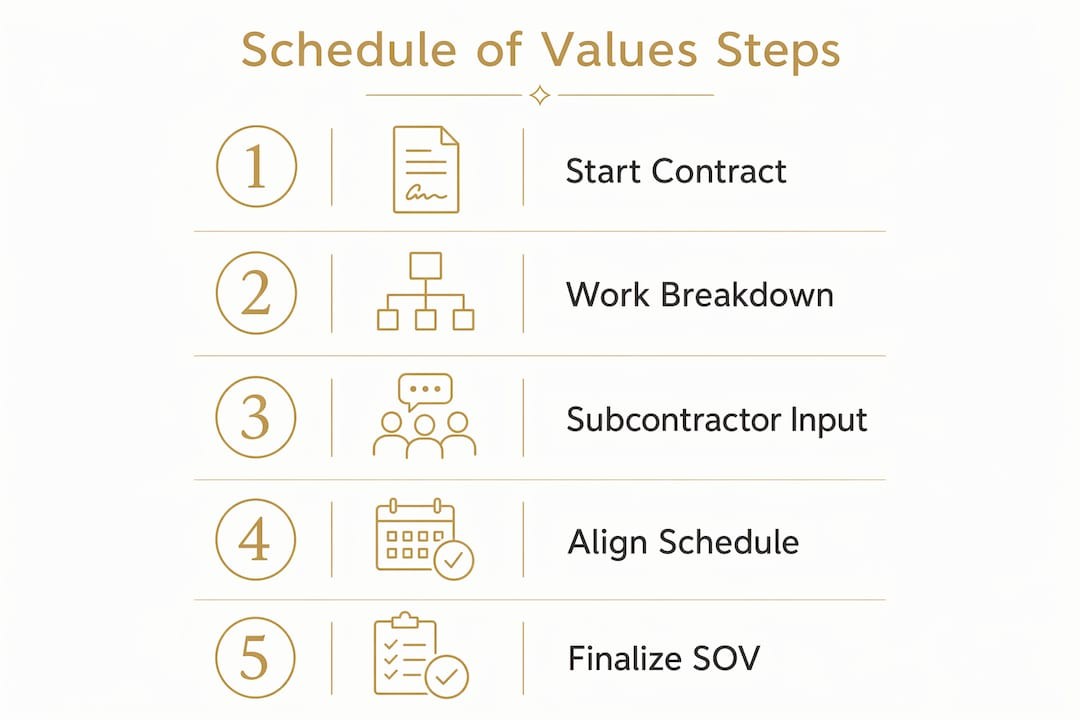
Break the work into logical, inspectable segments. Each line item should represent a scope that a third party can physically verify in the field. “Framing” is inspectable. “General construction” is not. The number of line items varies with project size, contract and lender requirements. Some published guides cite ranges for commercial work, but those are not rules, and no residential line-item count is a standard. Go too broad and the architect cannot certify completion with confidence. Go too granular and you create an administrative burden that slows every pay cycle.

Pull in subcontractor input early. If electrical, plumbing, and HVAC are subcontracted, get their breakdowns before you finalize the SOV. Their scopes need to be represented accurately, and their cash flow depends on it.
Submit a pencil draft first. Before locking in the SOV, send a preliminary version to the owner and architect. This collaborative review catches misalignments between the owner’s expectations and your cost breakdown before they become payment disputes.
Common pitfalls to avoid:
- Front-loading values to improve early cash flow. Owners and architects recognize this immediately, and it damages trust.
- Lumping unrelated scopes into a single line item to reduce paperwork. If one scope finishes early and the other runs long, you cannot bill accurately.
- Omitting indirect costs like general conditions, bonds, and insurance. These belong in the SOV as their own line items.
- Skipping the approval step. An SOV that has not been reviewed and approved before the first pay application creates problems that compound over the life of the project.
Pro Tip: Align your SOV line items with your project schedule’s work breakdown structure. When your billing milestones match your schedule milestones, progress reporting and payment applications become far less time-consuming.
What every SOV document needs to include
A well-structured SOV is more than a list of numbers. Each column carries a specific function, and missing any of them creates gaps that slow payment or invite disputes.
| Column | What It Captures |
|---|---|
| Item number | Sequential identifier for each line item |
| Description of work | Clear scope label (e.g., “Concrete Foundations,” “Rough Electrical”) |
| Scheduled value | Dollar amount allocated to that scope |
| Start and end date | Planned dates for each work segment |
| Work completed (previous) | Amount billed in prior pay applications |
| Work completed (current period) | New work completed since the last application |
| Stored materials | Materials on-site but not yet installed |
| Total completed + stored to date | Running total of completed work and stored materials |
| Percent complete | Calculated percentage of the scheduled value earned |
| Balance to finish | Remaining value not yet billed |
| Retainage | Portion withheld, if your contract provides for it; the percentage and release terms are set by the contract and applicable law |
Retainage, where used, is a portion of each progress payment held back until completion terms are met. Whether retainage applies, how much, and when it is released are set by the contract and by state law, and some jurisdictions regulate retainage on certain projects. Confirm the terms with your contract documents, your lender and, if needed, a Utah construction attorney. No percentage here should be treated as standard.
Change orders deserve their own line items. When the owner approves additional scope, that work gets added as a new SOV line rather than folded into an existing one. This keeps the audit trail clean and prevents confusion about what was in the original contract versus what was added later.
How construction projects use an SOV to manage payments and track progress
The SOV drives the monthly pay application cycle. At the end of each billing period, the contractor updates each line item to reflect work completed and submits the application, typically on AIA G702 (the cover sheet) and G703 (the continuation sheet), to the architect for review. The architect walks the site, compares observed progress to the claimed percentages, and certifies the application for payment. The owner then releases funds, minus retainage.
This cycle repeats every month until final completion. Each iteration builds on the last, so the SOV functions as a running ledger of what has been paid, what is in progress, and what remains.
Unclear billing documentation can slow payment approval. A well-organized SOV gives the reviewer a clearer basis for approving a pay application, though approval timing still depends on the contract, the reviewer and any lender.
The SOV can also serve as a cash-flow planning tool. Where a lender is involved, owners may use it to anticipate billing peaks and discuss the draw schedule, but each lender sets its own draw process. Contractors use it to project when payments will arrive and plan subcontractor pay accordingly. On complex projects, an SOV-based pay application usually gives more line-item visibility than a simple milestone schedule. Many residential contracts use milestone or draw schedules instead, and both approaches are common.
On the software side, platforms like Procore, Sage 300 CRE, and Viewpoint Vista integrate SOV data directly into project accounting, so updates flow through to cost reports and financial dashboards without manual re-entry. Software integration may matter more as project size grows. Large multi-unit projects with many subcontractors can be hard to manage in a spreadsheet. Many single-family projects do not need this software.
SOV templates and real construction project examples
One commonly used format pairs the AIA G703 Continuation Sheet with the G702 Application and Certificate for Payment. The G703 provides line-item detail and the G702 summarizes the application. Whether these forms and architect certification apply depends on the contract.
Other contract families, such as ConsensusDocs, publish their own payment-application forms. Check which forms your contract names.
UNVERIFIED LEGACY EXAMPLE, not a 2026 current quote or budget: the simplified table below is illustrative only. It uses a hypothetical $450,000 home. Cells shown as dashes were not recoverable from the legacy source, and the percentages and amounts are not benchmarks for any real project.
| Item | Description | Scheduled Value | % Complete | Completed to Date | Balance to Finish |
|---|---|---|---|---|---|
| 1 | General Conditions | — | 60% | — | — |
| — | Site Work & Excavation | — | — | — | — |
| — | Concrete Foundations | — | — | — | — |
| — | Framing | — | — | — | — |
| 5 | Roofing | — | — | — | — |
| — | Rough Electrical | — | — | — | — |
| — | Rough Plumbing | — | — | — | — |
| — | HVAC | — | 50% | — | — |
| — | Insulation | — | 0% | — | — |
| 10 | Drywall | — | 0% | — | — |
| 11 | Interior Finishes | — | 0% | — | — |
| 12 | Exterior Finishes | $31,500 | 20% | — | $25,200 |
| 13 | Cabinets & Millwork | $40,500 | 0% | — | $40,500 |
| 14 | Flooring | — | 0% | — | — |
| 15 | Final Cleanup & Punch | — | 0% | — | — |
| Total | $450,000 | $195,525 | $254,475 |
To customize a template for your project, start with the AIA G703 structure and replace the generic line item descriptions with your actual scope breakdown. Add columns for stored materials and retainage if your contract requires them. Keep the total column locked to your contract sum and build a formula that flags any discrepancy automatically.
Pro Tip: Save a master SOV template with your standard line item categories and formulas. For each new project, duplicate it and adjust the descriptions and values. A reusable template can reduce repeat setup work, though each project's scope still needs its own review.
Industry best practices for managing your SOV effectively
The following habits can help reduce payment friction, though disputes can still occur.

Get approval before the first pay application. Owner and architect approval of the SOV before any billing begins can help surface disagreements early. If the owner disagrees with how you have allocated values, you want to know that in week one, not week twelve.
Maintain defensible granularity. Each line item should represent a scope a third party can inspect and verify. Change orders are added as new SOV lines to preserve a clean audit trail, separate from original contract items. Folding approved changes into existing line items obscures the financial history of the project.
Update the SOV with every pay application. An SOV that does not reflect current project status is worse than no SOV at all. It creates a gap between what the document says and what the field shows, and that gap is where disputes are born.
Do not neglect stored materials. Whether stored materials can be billed depends on the contract and on any lender requirements. Where permitted, these items are commonly documented separately and may require owner or lender approval, insurance and inventory records.
Clear billing documentation can help reviewers understand what is being billed. It does not guarantee faster payment, because payment timing depends on the contract, the reviewer and any lender.
Reconcile the SOV against your cost report monthly. The SOV tracks what you are entitled to bill. Your cost report tracks what you are actually spending. Comparing the two each month reveals whether you are ahead of or behind your budget on each scope, giving you time to course-correct before a problem becomes a loss.
Reducing payment delays is one of the clearest benefits of a well-managed SOV. You can learn more about construction payment management and how proper documentation protects every party on a project.
How an SOV protects you in disputes and claims
When a payment dispute lands in mediation or litigation, the SOV becomes one of the most important documents in the file. It establishes what was agreed to, what was completed, and what was paid, in a format that an arbitrator, judge, or mediator can follow without a construction background.
Written, contemporaneous billing records can be useful evidence if a payment dispute arises. An SOV that was reviewed and approved during the project is easier to follow than informal emails or verbal agreements. How a mediator, arbitrator or court weighs any document depends on the contract and the facts, so ask an attorney about your situation.
Change orders are where disputes most often originate. When additional scope is added as a new SOV line item with its own approved value, the paper trail is unambiguous. The owner signed off on the change, the value was documented, and the billing follows directly from that approval. Without that structure, change order disputes become a “he said, she said” problem with no clean resolution.
Subcontractors benefit from the SOV’s dispute-resolution function as well. When a general contractor’s pay application is certified and paid, the SOV provides the documentation subcontractors need to verify that their scope was included in the billing and that payment flows down appropriately. On projects governed by pay-when-paid or pay-if-paid clauses, this transparency matters.
Legal and contractual obligations tied to the SOV
Whether an SOV is required depends on the contract. Where AIA A201-2017 governs, section 9.2 provides for a schedule of values submitted before the first application for payment, subject to the architect’s review. Other contract forms vary. Many residential contracts use their own payment terms, so read your contract. This is general information, not legal advice.
Federally funded or federally assisted projects can carry additional wage and documentation requirements, such as under the Davis-Bacon Act. What those mean for billing depends on the project and contract. This applies to residential custom homes only if federal funding is involved, so confirm with the funding agency or an attorney.
State prompt-payment laws may set payment deadlines, and Utah has its own rules for construction payment. Which rules apply, and how their deadlines are triggered, depends on the contract type and the facts, so confirm current Utah requirements with an attorney or the state. An unclear SOV can slow the approval step in a pay application.
Some lenders ask for an SOV or similar cost breakdown with draw requests, but requirements vary by lender and loan. Draw schedules, inspections and documentation are set by your lender, so ask them what they require. A poorly organized cost breakdown can slow draw review.
Billing records may be relevant if a lien or payment claim arises. Lien rights depend on state law, including notice and filing requirements, and an SOV does not by itself establish a lien claim. Consult a Utah construction attorney for guidance.
Discuss Construction Payment Terms Before Signing
Building a custom home or remodeling your existing space in Washington or Iron County, Utah, means navigating contracts, payment schedules, and construction timelines that can feel opaque if your builder does not explain them clearly. Ask the proposed contractor to explain the written payment terms and supporting records.
Payment terms for a Prestigioushome project are set in that project’s written contract. Ask for the payment schedule, how progress is documented, and how change orders are handled before you sign, and compare them to what your lender requires. If you are planning a custom home build or a full remodel, ask Prestigious Home Builders which payment documentation and communication arrangements are proposed. Reach out to start a conversation about your project.
Key Takeaways
A Schedule of Values can organize billing where the contract uses one. Review it with the applicable contract and lender requirements; clear records do not guarantee timely payment or prevent disputes.
| Point | Details |
|---|---|
| SOV depends on the contract | Where AIA A201-2017 governs, section 9.2 provides for an SOV before the first pay application; other contracts vary. |
| Clear documentation helps review | Clear billing documentation can make pay applications easier to review. |
| Retainage is contract-specific | Whether retainage applies, how much, and when it is released is set by the contract and applicable law. |
| Change orders need separate lines | Adding approved change orders as new SOV line items preserves a clean audit trail and prevents billing disputes. |
| Payment terms are in your contract | Review payment terms, documentation and change-order handling in the written contract before signing. |
References and Verification
These references support the planning distinctions above, not a project-specific approval, incentive award or financial outcome. Verify the rules and documents applicable to your address, installation date and agreement.
Plan the Next Step
Explore New Home Construction and request a consultation for your proposed construction scope. For broader construction coordination, explore General Contractor services.