
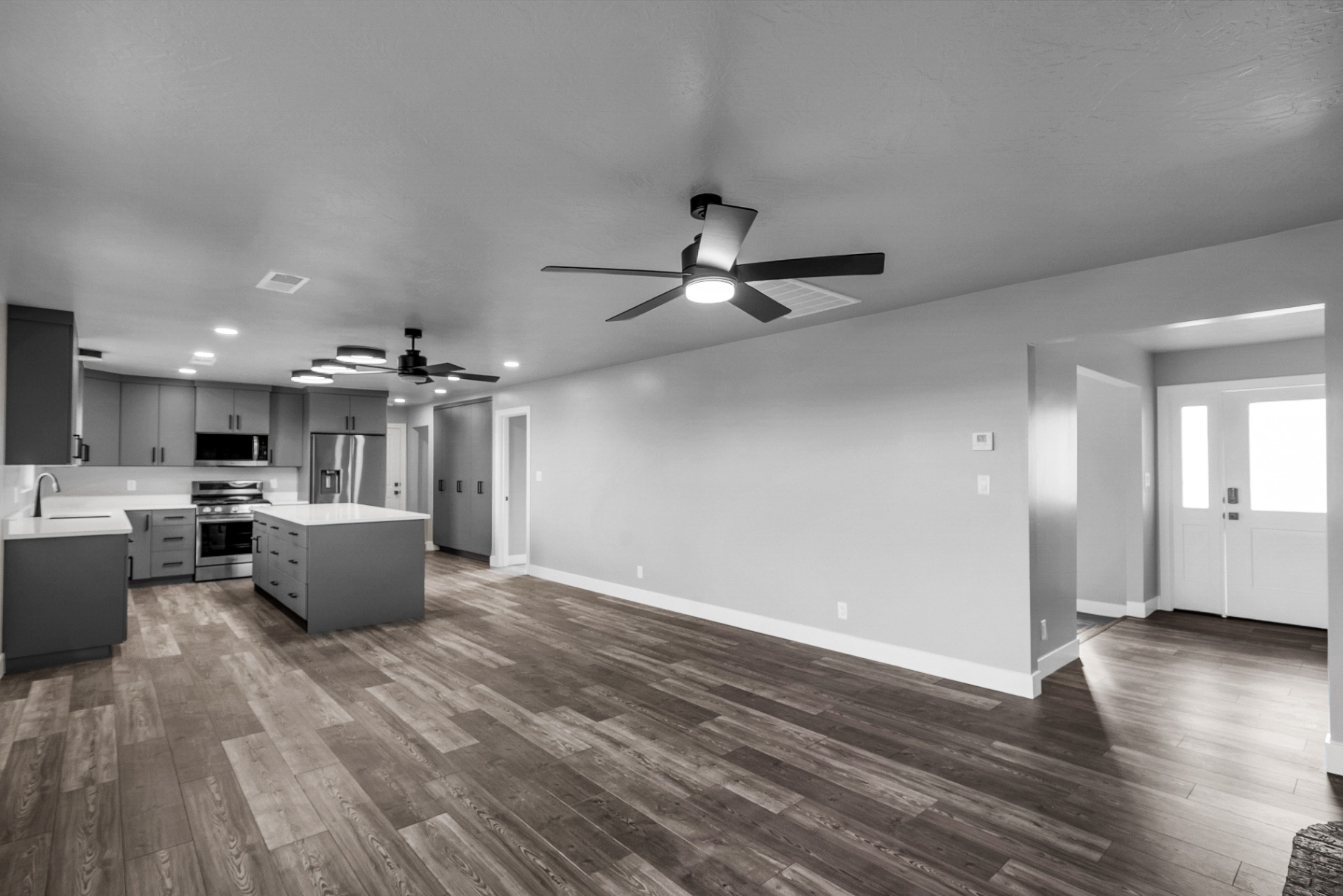
Energy Efficient Kitchen Remodel: What to Upgrade First

An energy efficient kitchen remodel comes down to five decisions: a layout that keeps work short and appliances apart from heat, ENERGY STAR appliances sized to your household, efficient lighting, properly planned ventilation, and durable materials you will not need to replace in ten years. Get those right at the design stage and the savings follow without a separate “green” budget. Below is how to make each choice, what the numbers say, and where a Utah homeowner should spend first.
TL;DR
- The kitchen is estimated to account for 20 to 40% of a home’s energy bill, so appliances and lighting are where the savings are.
- Choose ENERGY STAR appliances and size them honestly: a smaller refrigerator or dishwasher you actually fill beats a large one that runs half empty.
- Plan lighting, ventilation and appliance placement together on the drawings, before cabinets are ordered.
- Pick durable, low-VOC materials. A kitchen that does not need redoing in ten years is the most sustainable one.
- At our Utah price points, a small kitchen remodel runs $20,000 to $40,000 and a mid-range one $40,000 to $70,000, with efficiency choices built into either.
Table of Contents
- Start with how the kitchen is actually used
- Appliances: where most of the savings are
- Lighting that uses less and works better
- Ventilation: efficient and safe
- Materials and plumbing that last
- What an energy efficient kitchen costs in Utah
- Our perspective
- Plan your efficient kitchen with us
- FAQ
- Sources
Start with how the kitchen is actually used
Before you pick a single appliance, look at what is wrong with the room you have. Planning guidance for green kitchen remodels starts by assessing layout and comfort problems: is the kitchen too hot in the afternoon, are the refrigerator and range fighting for the same corner, do you walk across the room for every task? It also advises keeping the kitchen size reasonable, because extra square footage and extra equipment carry their own energy and resource cost.
That matters in the Southern Utah climate, where summer afternoons are long and hot. A kitchen that adds heat from the oven and the refrigerator compressor into the same corner makes your air conditioner work harder. A short list of questions to answer before design starts:
- Which tasks do you do daily, and which only at holidays?
- Do you cook for two or for eight on a normal weeknight?
- Which wall gets the most afternoon sun?
- Are there hot spots, drafts or dark corners you work around today?
- Do you want the kitchen larger, or just better organized?
The last question deserves attention. Many families asking for a bigger kitchen really need a better work triangle and smarter storage. If you want to test your layout against real dimensions, our guide to kitchen layout ideas with NKBA numbers walks through clearances and work aisles. Keeping walkways short and arranging appliances ergonomically is also the advice in a Swiss kitchen planning guide, which suggests orienting the main activity area toward a view or a communication area so the space works for people instead of against them.
Appliances: where most of the savings are
A large share of a household’s electricity goes to a few machines. One national resource guide puts air conditioners, water heaters and refrigerators at about 75% of a home’s electricity use. That figure comes from Singapore, where air conditioning dominates, so treat it as a sign of direction rather than a Utah number. The refrigerator, though, runs 24 hours a day in every home, which is why it is the first appliance to get right.
Refrigerators
Look for the ENERGY STAR label on the refrigerator, and match its size to your household. Seattle’s green home guide recommends ENERGY STAR labeled appliances and sizing refrigerators and dishwashers to your needs, and suggests a smaller model if yours is consistently half full. The same guide notes that top-freezer models generally use up to 25% less energy than comparable side-by-side models. If you love a French-door or side-by-side layout, compare the yellow EnergyGuide kWh figure between specific models rather than assuming.
Placement counts as much as the model. Leave enough clearance around the refrigerator for air to circulate, and keep it away from heat sources such as the range, the dishwasher vent and a west-facing window. This is a design decision, so it belongs in the plan, not in the installer’s hands on delivery day.
Dishwashers
The dishwasher is the easiest upgrade to justify. The EPA’s water efficiency guide says replacing existing units with ENERGY STAR labeled models reduces water use by up to 65% and energy use by more than 10%. It also states that standard-size ENERGY STAR certified dishwashers may not exceed 3.5 gallons per load, and compact models 3.1 gallons per load. In a region where water conservation is a daily conversation, that is a meaningful difference over years of use.

Cooktops and ovens
Induction is the efficiency leader for stovetop cooking. A Boston building guide notes that induction stoves waste less heat and are typically more efficient than gas, and adds that they give cooks better temperature control, reduce indoor air pollution and lower the risk of burns. Less wasted heat also means less heat in the room, which helps in a Utah summer.
For small meals, you do not need the full-size oven. A utility guide from the UAE says toaster ovens, small electric pans or microwaves can use one-third to one-half as much energy as large ovens. Designing a counter-level spot for a countertop oven or air fryer, with its own outlet, makes that habit easy.
A quick comparison
| Appliance | What to look for | Source-backed benefit |
|---|---|---|
| Refrigerator | ENERGY STAR, right size, top freezer if it suits you | Top-freezer models generally use up to 25% less than comparable side-by-side models |
| Dishwasher | ENERGY STAR, 3.5 gallons per load or less (standard) | Up to 65% less water and more than 10% less energy than older units |
| Cooktop | Induction | Less wasted heat, better control, lower burn risk |
| Small cooking | Countertop oven, electric pan, microwave | One-third to one-half the energy of a large oven for small meals |
One practical point on timing: federal tax credits for efficient home improvements have changed. The 25C credit expired on December 31, 2025, so do not budget around it. Check your utility’s current rebate programs and ask your tax professional what applies to your project. Our guide to energy efficient home upgrades covers the wider picture beyond the kitchen.
Lighting that uses less and works better
Lighting typically accounts for almost 15% of a household’s electricity use, according to Rutgers University’s green building manual. A kitchen is where the right lighting plan pays back twice: lower bills, and a room where you can actually see the cutting board.
The approach that works:
- Layer the light. Use task lighting under the upper cabinets and over the island, so you light the work surface instead of flooding the whole room at full brightness.
- Use LED throughout. Recessed cans, pendants and under-cabinet strips all come in LED today. Put them on dimmers so you can run the room at a lower level in the evening.
- Go light on the surfaces. Light colors on walls and large furniture reflect heat and light, so you need fewer fixtures to reach the same brightness. Light-colored window coverings help too.
- Use daylight on purpose. In Washington and Iron Counties, low-E glass and exterior shade on south and west windows let you keep the light and cut the heat. Our piece on desert home windows, insulation and shade explains the options.
Ventilation: efficient and safe
A range hood has one job: remove steam, grease and combustion byproducts. It also pulls conditioned air out of your house, so sizing matters. Washington State’s energy code (WAC 51-13) requires kitchen ventilation with a minimum fan flow rating of 100 CFM. That is a Washington State rule, not a Utah one, so confirm requirements with your local building department, but it is a useful reference point for a quiet, efficient fan.
The same Seattle guide includes a safety warning worth taking seriously: powerful hoods and downdraft fans can create a health hazard by pulling exhaust from furnaces, fireplaces and water heaters back into the home. If you are choosing a high-output hood over a gas range, ask your contractor whether the house needs a makeup air solution, and have combustion appliances checked. Switching to induction removes the gas combustion from the equation at the range, though not from other appliances in the home.
Materials and plumbing that last
A sustainable kitchen focuses on long-term durability and timeless function, which reduces the need for future renovations. Few decisions save more resources than not tearing out a kitchen after ten years.
Durable, lower-impact choices that PATHNet’s kitchen guidance lists:
- Flooring: bamboo, recycled-content tile, concrete, or reclaimed or sustainably certified wood.
- Paints and finishes: low- or no-VOC products, which keep indoor air cleaner.
- Plumbing: PEX piping with a manifold, which the same source says can use 43% less water than conventional copper piping while improving durability. The shorter wait for hot water is the reason.
Beyond the lists, think about cabinets and counters. Keeping solid existing cabinet boxes and refacing them can lower both cost and waste, where the layout allows. Quartz and similar surfaces resist staining and heat without the sealing upkeep of some natural stones.
Once the kitchen is finished, how you set it up decides whether it stays efficient and easy to use. A guide to organizing your kitchen workflow after renovation shows how to arrange the finished space so daily habits match the design.
What an energy efficient kitchen costs in Utah
Efficiency is not a separate line item you add at the end. It shows up in the appliance package, the lighting plan, the window and ventilation details and the materials. Our published ranges for kitchen work in Utah are:
| Project | Published range |
|---|---|
| Small kitchen remodel | $20,000 to $40,000 |
| Mid-range kitchen remodel | $40,000 to $70,000 |
| Kitchen expansion (addition) | $50,000 to $150,000 |
| Luxury kitchen remodel | Scoped per project |
What moves a kitchen within a range is mostly the appliance tier, cabinetry, counter material and whether walls or plumbing move. If you want to know where the money goes, read what the most expensive part of a kitchen remodel is. Appliances are a good place to spend selectively: an ENERGY STAR dishwasher and refrigerator cost little more than standard models in many lines, and the lower running costs continue for the life of the machine.
Order of operations
Efficient kitchens are decided early. Long-lead items such as appliances, windows and custom cabinets need to be specified before demolition so the rough-in (electrical circuits for induction, venting, plumbing) matches the final choices. Our kitchen remodel timeline lists what to order first, and how long a kitchen remodel takes gives realistic ranges.
Our perspective
We see the same pattern on most kitchen projects in Washington and Iron Counties: homeowners start with a finish board and add efficiency at the end, when the layout, electrical plan and window openings are already fixed. That is backwards. The efficient choices are cheapest when they are drawn on paper first.
That is why we build the design phase around virtual consultations and 3D renderings. When you can walk through the kitchen on screen, you notice that the refrigerator sits beside the range, that the west window will bake the countertop in July, or that the island needs a second circuit. Fixing those items on a rendering costs nothing. Fixing them after framing costs real money.
Our approach is designed around one point of contact for both design and construction, so the person who hears you say “we want lower bills and a calmer kitchen” is the person who coordinates the electrician, the appliance order and the ventilation. We think a clear, itemized process from planning to completion is part of an efficient project, because surprises waste money and materials.
Our advice: decide your appliance package and lighting plan before you pick cabinets, spend on the machines that run every day, and build for ten-plus years of use.
Jake
Plan your efficient kitchen with us
If you are ready to remodel in Washington or Iron County, we handle the design and the construction under one roof. You can see how a kitchen project runs, from virtual consultation and 3D renderings through to completion, on our kitchen remodeling page.

If your plans include more space, our room addition services cover kitchen expansions, and for a full-house update there are mid-sized remodels. Bring your must-haves, your utility bills and your budget, and we will show you what an efficient version of your kitchen looks like before anything is built. You can also start from our home page.
FAQ
Which kitchen upgrade saves the most energy?
The refrigerator and dishwasher are the best starting points because they run or get used every day. ENERGY STAR dishwashers use up to 65% less water and more than 10% less energy than older units. Efficient lighting is the next step.
Is an induction cooktop worth it in an efficient kitchen?
Induction wastes less heat and is typically more efficient than gas, and it offers precise temperature control and a lower burn risk. Check that your electrical panel and kitchen circuits can support it, and plan the circuit during design.
How much does an energy efficient kitchen remodel cost?
At our published ranges, a small kitchen remodel runs $20,000 to $40,000 and a mid-range remodel $40,000 to $70,000. Efficient appliances, LED lighting and durable materials are choices within those ranges, not a separate add-on.
Do I need a bigger kitchen to make it efficient?
No. Guidance for green remodels advises keeping the kitchen size reasonable and focusing on how the space is used. A better layout, right-sized appliances and good lighting often do more than added square footage.
Do tax credits still apply to efficient upgrades?
The federal 25C credit expired on December 31, 2025. Ask your tax professional and your local utility about current programs before you count on any incentive.
Sources
- Remodel Project: Kitchen, GreenBuildingAdvisor
- The Kitchen Guide, Küche Schweiz
- Kitchen green home guide, Seattle Office of Sustainability and Environment
- Resource efficiency guide for homeowners, Singapore NEA
- Water Efficiency Management Guide: Residential Kitchen and Laundry, EPA
- BERDO Building Guide, City of Boston
- General energy saving tips, DEWA
- Kitchen, Bath, and Living Spaces, Rutgers Green Manual
- The kitchen, PATHNet
- Kitchens, Ecohome
- 25C Heat Pump Federal Tax Credits, Rewiring America
- Organizing workflow after renovation
Recommended
Images in this article are editorial illustrations, not Prestigious project photography.