
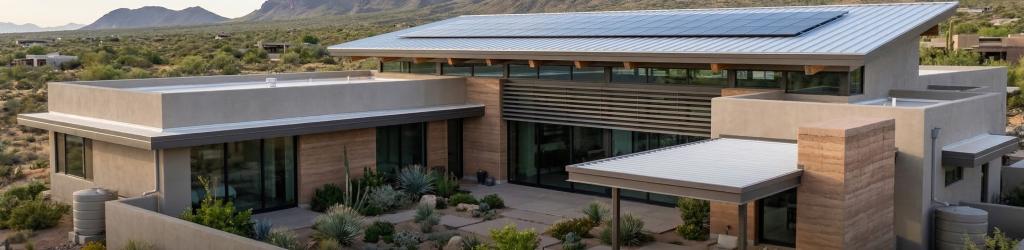
A high-desert design brief should connect climate, site, household needs, and maintenance expectations. Discuss these five feature groups with the project team rather than assuming a standard company assembly or guaranteed service life.
Thermal Mass and the “Thermal Lag” Strategy
Daily temperature swings vary by location, season, and elevation. Use local weather data and energy modeling to assess heating and cooling demands instead of assuming a universal 40-degree swing.
The Physics of Thermal Lag
Thermal mass absorbs and releases heat over time. Adobe, rammed earth, and concrete can moderate temperature swings when their placement, insulation, shading, and night cooling fit the climate. Mass alone does not ensure cool days or warm nights.
Polished Concrete and Stone
Polished concrete and stone can provide exposed interior thermal mass as well as a finish. Useful storage depends on thickness, exposed area, solar access, floor coverings, and the building’s heating and cooling strategy.
The Insulation-Mass Hybrid
Insulation and thermal mass serve different functions. A designer should specify their location, continuity, moisture control, and structural connections for the actual assembly. No documented company-wide sandwich system or year-round efficiency guarantee is established here.
Advanced Solar Orientation and Shading
Solar orientation can influence seasonal heat gain and shading opportunities. Evaluate it alongside lot geometry, views, access, and envelope design; it is not necessarily the most cost-effective measure on every site.
Passive Solar Placement
An east-west building axis and carefully placed north- and south-facing glazing may help manage solar exposure. Select orientation from site analysis rather than requiring the same window direction on every lot.
Deep Overhangs and Brise-Soleil
Size overhangs and external shades for orientation, seasonal sun angles, and window height. Horizontal overhangs are less effective against low east or west sun; shading does not guarantee comfort.
UV-Resistant Glazing
Choose glazing using whole-window U-factor, solar heat gain coefficient, visible transmittance, and any verified UV-transmission data. Low-E and spectrally selective coatings overlap in function; altitude alone does not show that standard low-E is insufficient. Verify product ratings and installation details rather than promising protection of furnishings.
Designing for High-Desert Wind and Dust
High-desert landscapes are often wide-open, leaving homes vulnerable to scouring winds and fine “blow sand.”
Wind-Shielded Courtyards
Courtyards and U- or O-shaped plans may provide sheltered outdoor areas, but wind direction, turbulence, and enclosure geometry matter. Evaluate local exposure before promising a comfortable microclimate.
Dust Mitigation Entryways
Vestibules, mudrooms, air sealing, and maintained weather stripping may reduce dust entry. Design ventilation, filtration, and pressure balance with a qualified mechanical professional; pressurizing a house is not a universal solution and cannot make it allergen-free.
Water-Wise Systems and Xeriscaping
Xeriscaping combines climate-appropriate planting, soil preparation, mulch, efficient irrigation, and maintenance. Drought-tolerant planting may still need establishment and seasonal watering; it does not mean no irrigation.
Hydro-Zoning
Group plants with similar water needs and match irrigation to soil, exposure, weather, and establishment stage. Hydro-zoning may reduce overwatering, but savings and plant health depend on operation and maintenance.
Active vs. Passive Water Harvesting
- Active harvesting: Assess roof collection, tank capacity, filtration, overflow, maintenance, and current state and local requirements before installing a rainwater system.
- Passive harvesting: Have grading and drainage reviewed so swales and basins do not direct water toward foundations, neighboring parcels, or unstable soils.
Greywater Recycling
Greywater may be suitable for some projects, subject to current health, plumbing, permitting, and irrigation rules. A qualified designer should assess permitted sources, treatment, distribution, and maintenance. Not every indoor water use can safely be reused outside.
Durable, High-Performance Material Palette
Heat, UV exposure, wind, moisture, and freeze-thaw cycles can affect materials differently. Compare rated assemblies, fastening, flashing, coatings, and maintenance requirements rather than assuming all standard materials fail within a few years.
Reflective “Cool” Roofing
Evaluate roofing products by tested solar reflectance, thermal emittance, assembly fire classification, wind resistance, and climate suitability. Metal or tile is not automatically highly reflective, and cooling benefits depend on the full roof and building.
Fire-Resistant Building Envelopes
Where wildfire exposure warrants it, discuss tested roof assemblies, ember-resistant vents, defensible space, and locally applicable requirements with qualified professionals. Material labels alone do not establish a noncombustible or ember-proof home, and this source does not verify a company-wide construction practice.
Wood and Humidity
Wood movement and checking depend on species, moisture content, exposure, detailing, and maintenance, not a universal humidity threshold. Thermally modified wood may be an option, but compare product-specific durability, fastening, finish, and warranty limits.
The High-Desert Maintenance Checklist
Prepare a product- and site-specific maintenance plan. UV exposure, sealant movement, and wind-driven dust can increase maintenance demands; no documented company-issued schedule is established here.
- Inspect weather stripping and sealants at manufacturer-recommended intervals and after damaging weather.
- Recoat wood based on the product, finish condition, and exposure rather than a universal two- to three-year interval.
- Have movement joints and drainage details checked when signs of deterioration appear; do not alter structural gaps without professional advice.
People Also Ask (FAQ)
What is the best color for a desert home?
Light colors often absorb less solar energy than dark ones, but measured product reflectance, orientation, insulation, and local design rules matter. Color alone cannot establish cooling savings.
Do I need a special roof for the desert?
Roof selection should address local snow, wind, fire exposure, drainage, structure, and maintenance. Metal and tile are options, not universally the most durable or appropriate choices.
Is it expensive to build for the desert?
Some climate-responsive features increase upfront cost. Compare installed cost, modeled energy use, maintenance, and service-life assumptions; thousands of dollars in lifetime savings are not established or guaranteed.
Can I have a pool in a high-desert climate?
A pool may be feasible subject to water availability, permits, setbacks, structural conditions, and operating costs. Covers and wind protection may reduce evaporation but cannot prevent it entirely. Confirm whether pool design is included in the project scope.
How do I stop my windows from leaking heat?
Compare whole-window ratings and installation details. Thermal breaks reduce conductive heat transfer through metal frames; they do not stop it. Air sealing, glazing selection, shading, and insulation continuity all matter.
Build Your Desert Masterpiece with Prestigious Home Builders
Discuss climate-responsive options with Prestigious Home Builders. Confirm professional design responsibilities and specifications in the project agreement; this source does not substantiate decades of expertise or guaranteed resilience.
Whether you are looking to build a custom estate in St. George or a modern retreat in the high plains, our team is ready to guide you through every step of the process.
Ready to start your project? Contact Prestigious Home Builders today for a consultation and let’s build a home that thrives in the desert.
Plan the Next Step
Explore New Home Construction and request a consultation about your proposed construction scope. Confirm deliverables, fees, responsibilities and availability in writing.