

For most homeowners, quartz is the better everyday countertop. It requires no sealing, resists stains from coffee and wine without any treatment, and delivers a consistent look that works across modern and transitional kitchens. Granite earns its place when you want a one-of-a-kind natural slab, cook at high heat without thinking about trivets, or prefer a material with zero synthetic content.
Quick picks by use case:
- Heavy cook who sets hot pans directly on the counter: Granite. It tolerates temperatures up to roughly 1,200°F; quartz resin begins to degrade around 300°F–400°F.
- Busy family that wants low maintenance: Quartz. No annual sealing, no absorption worries, and stain resistance against everyday spills.
- Outdoor kitchen: Granite. Quartz is UV-sensitive and most manufacturer warranties exclude outdoor installations.
- Tight budget: Either. Installed costs overlap significantly, though entry-level granite can start slightly lower.
- High-end natural-stone look with unique veining: Granite. No two slabs are the same.
Prestigioushome works with homeowners across Washington and Iron Counties in Utah on exactly this decision, and the breakdown below gives you everything you need to choose with confidence.
Table of Contents
- What quartz and granite are actually made of
- How quartz and granite compare across what actually matters
- How quartz and granite look different, and where each design fits
- How to decide: a checklist for homeowners
- Cleaning, sealing, and repairing each material
- Price ranges, installation timelines, and what warranties actually cover
- What the market data say about quartz and granite right now
- Key Takeaways
- The choice most homeowners get wrong
- Prestigioushome makes the countertop decision part of a bigger picture
- Useful sources
What quartz and granite are actually made of
Understanding the composition is what makes every other comparison make sense.
Quartz (engineered stone):
- 90–95% ground quartz crystals bound with 5–10% polymer resins
- Manufactured under high pressure and heat in a factory, then polished to a consistent finish
- Pigments and sometimes recycled glass or mirror chips are added during production
- The resin content is what makes it non-porous and what limits its heat tolerance
Granite (natural igneous stone):
- Formed over millions of years as magma cools slowly underground
- Composed primarily of quartz, feldspar, and mica, with trace minerals that create its color variation
- Quarried as large blocks, then cut into slabs and polished at a fabrication facility
- Porosity varies by slab because the mineral composition is never identical
Heat tolerance: Granite handles temperatures up to approximately 1,200°F. Quartz resin binders begin to discolor or warp at roughly 300°F–400°F. A cast-iron skillet pulled straight from a 450°F oven is a real risk for quartz.
A note on quartzite vs. quartz: These are completely different materials. Quartzite is a natural metamorphic rock (similar to granite in care requirements) that is often confused with engineered quartz because of the name. If a slab yard shows you “quartzite,” ask for the absorption rate and sealing schedule. It behaves more like granite than like the engineered product.
How quartz and granite compare across what actually matters
The table below covers the dimensions that most affect a remodel decision. Cost figures reflect installed pricing.
| Dimension | Quartz | Granite |
|---|---|---|
| Appearance | Uniform patterns; consistent color across slabs | Unique veining and color variation; no two slabs identical |
| Heat resistance | Vulnerable above ~300°F–400°F (resin limit) | Tolerates up to ~1,200°F |
| Scratch resistance | Mohs ~7; slightly harder than most granite | Mohs ~6–6.5; highly scratch-resistant in daily use |
| Porosity / sealing | Non-porous; no sealing required | 0.4%–0.8% absorption; seal every 1–3 years |
| Maintenance | Wipe clean; no annual upkeep | Annual sealing; prompt stain response needed |
| Installed cost | $50–$150 per sq. ft. | $40–$175 per sq. ft. |
| Lifespan / resale | Decades with normal care; strong resale appeal | Decades; unique slabs can be a selling point |
| Outdoor use | Not recommended; UV degrades resin | Suitable for outdoor kitchens |
| Environmental factors | Manufactured; some recycled content possible | Natural stone; quarrying has a land footprint |
| Repairability | Chips can be filled with epoxy; color matching is harder | Chips and cracks repairable; natural variation helps hide repairs |
Decision-critical takeaways from the table:
- The heat row is the single biggest lifestyle filter. If you cook at high heat and don’t want to think about trivets, granite wins outright.
- Sealing is the ongoing cost most homeowners underestimate with granite. Budget 30–60 minutes and the cost of a quality sealer once a year, minimum.
- Quartz is not suitable for outdoor use in most cases. UV exposure yellows the resin, and most warranties will not cover it.
- At the midrange, both materials cost roughly the same installed. The price gap opens at the budget end (granite can go lower) and the exotic end (rare granite slabs push well past $150/sq. ft.).
How quartz and granite look different, and where each design fits
You can usually tell the two materials apart before you touch them.
Visual clues to identify each material:
- Pattern repeat: Quartz often shows a subtle repeat in its veining or aggregate pattern if you look across a large slab. Granite never repeats.
- Surface texture: Polished quartz has a glassy, almost plastic-like sheen. Polished granite has depth and slight variation in reflectivity because of its mineral structure.
- Temperature to touch: Granite feels noticeably cold. Quartz, because of its resin content, feels slightly less cold at room temperature.
- Edge consistency: Quartz edges are perfectly uniform in color and pattern. Granite edges often reveal the stone’s internal mineral layers.
Where each material fits design-wise:
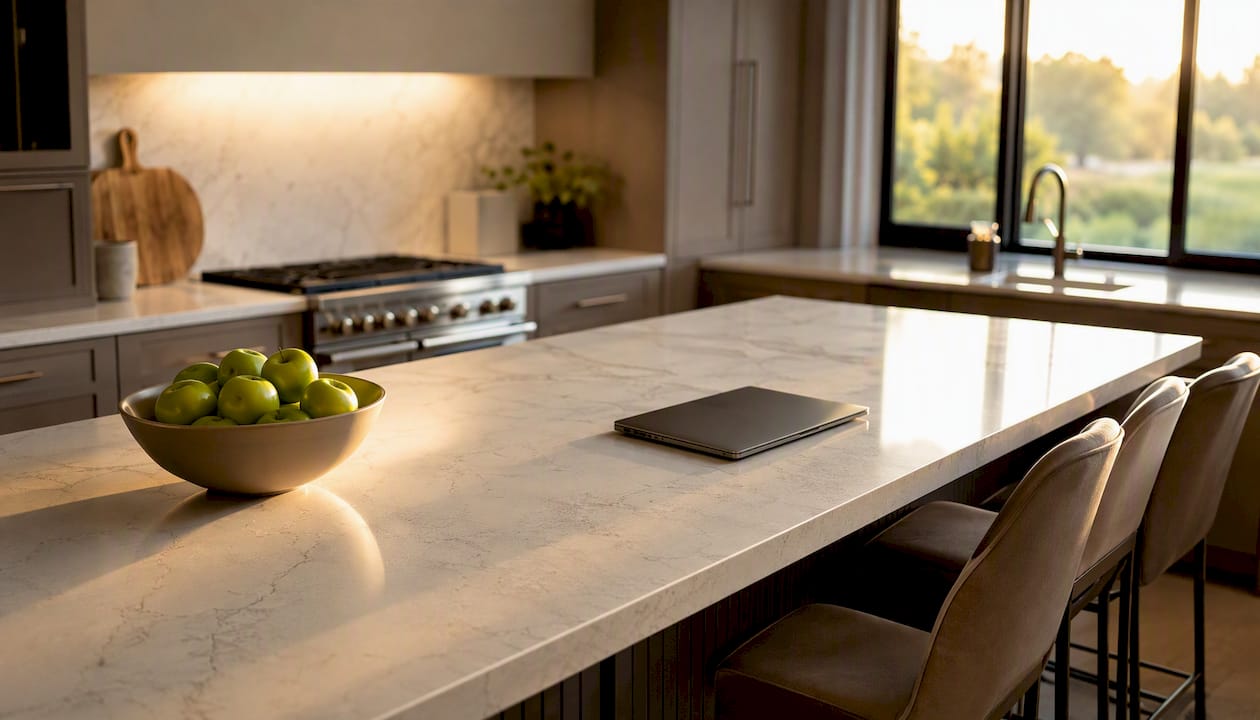
Quartz suits modern, minimalist, and Scandinavian-influenced kitchens where clean lines and a consistent backdrop matter. A white or light-gray quartz with subtle veining pairs well with flat-panel cabinetry and integrated appliances. The uniformity is an advantage when you have a large island and want the surface to read as one uninterrupted plane.
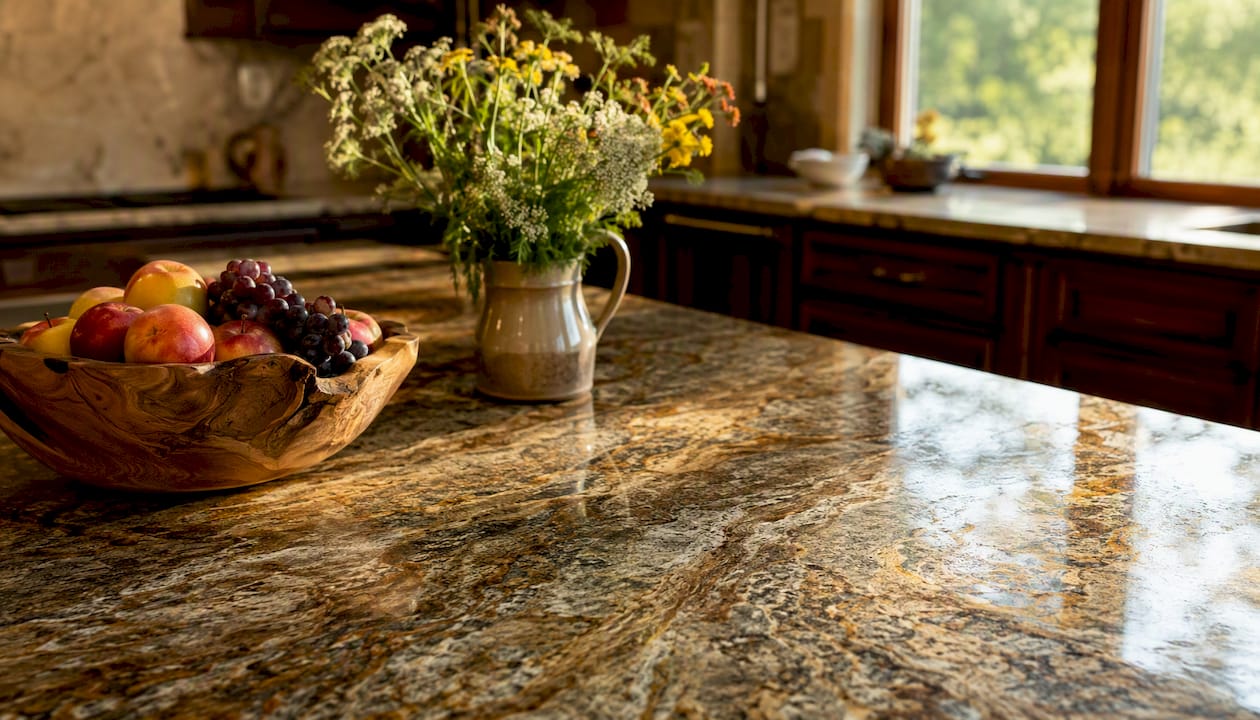
Granite works naturally in transitional, farmhouse, and traditional kitchens where the stone’s character is part of the design. A dramatic black-and-gold granite slab becomes a focal point in a way that engineered stone rarely does. Unique slabs also tend to hide seams better because the natural veining draws the eye away from the joint.
Finish options change the maintenance equation. A honed (matte) granite shows fingerprints less than polished but is more porous and needs sealing more often. A leathered finish on granite adds texture and hides water spots well. Honed quartz is increasingly popular in contemporary kitchens and carries the same no-seal benefit as its polished counterpart. Interior design trends in 2025 and 2026 have leaned toward warmer tones and organic textures, a shift that has boosted both leathered granite and warm-toned quartz. For a broader look at how surface finishes fit current interior design trends, it is worth reviewing what designers are specifying across the full room.
How to decide: a checklist for homeowners
Work through these in order. The first question that gives you a clear answer is usually the right one.
- Do you set hot pans directly on the counter? If yes, choose granite. No amount of habit-changing is worth the risk of a warped or discolored quartz surface.
- Do you want zero annual maintenance? If yes, choose quartz. The no-seal, wipe-clean profile is a genuine lifestyle advantage for busy households.
- Is this for an outdoor kitchen or a space with direct sun exposure? If yes, choose granite or a specifically rated outdoor stone. Quartz is not the right material here.
- Do you want a truly unique slab that no one else has? Granite. Quartz can mimic natural stone well, but it cannot replicate the one-of-a-kind quality of a specific granite slab.
- Is budget the primary constraint? Get quotes for both. Entry-level granite can undercut quartz slightly, but midrange pricing overlaps. Do not assume one is always cheaper.
Questions to ask your fabricator before signing:
- What is the absorption rate of this specific granite slab? (Not the category average, the actual slab.)
- What does the warranty cover, and does it exclude outdoor use or UV exposure for quartz?
- Where was this slab quarried, and does the fabricator have references for similar installations?
- For granite: what sealing frequency do you recommend for this specific stone, and what sealer do you use?
- For quartz: what is the UV rating, and is outdoor installation covered under any conditions?
Red flags during slab selection:
- A fabricator who cannot give you the absorption rate for a specific granite slab is guessing. Granite porosity varies across slabs, and some stones sold as “granite” need sealing far more often than the standard 1–3 year guidance.
- A vague warranty with no written exclusions is a problem for both materials.
- An unusually low quote often means thinner slabs, lower-grade material, or fabrication shortcuts that show up later.
Pro Tip: Before committing to a granite slab, pour a few drops of water on the surface and time how long it takes to absorb. If the stone darkens within a few minutes, it needs sealing before installation and likely more frequent maintenance than average.
Cleaning, sealing, and repairing each material
Daily care for quartz is about as simple as countertop maintenance gets. Wipe spills with a damp cloth and mild dish soap. Avoid abrasive scrubbers, which can dull the surface over time, and skip bleach-based cleaners on colored quartz. For stuck-on food, a plastic scraper works without scratching. Quartz does not need any sealing, ever. The resin binders that limit its heat tolerance are the same reason it sheds stains without treatment.
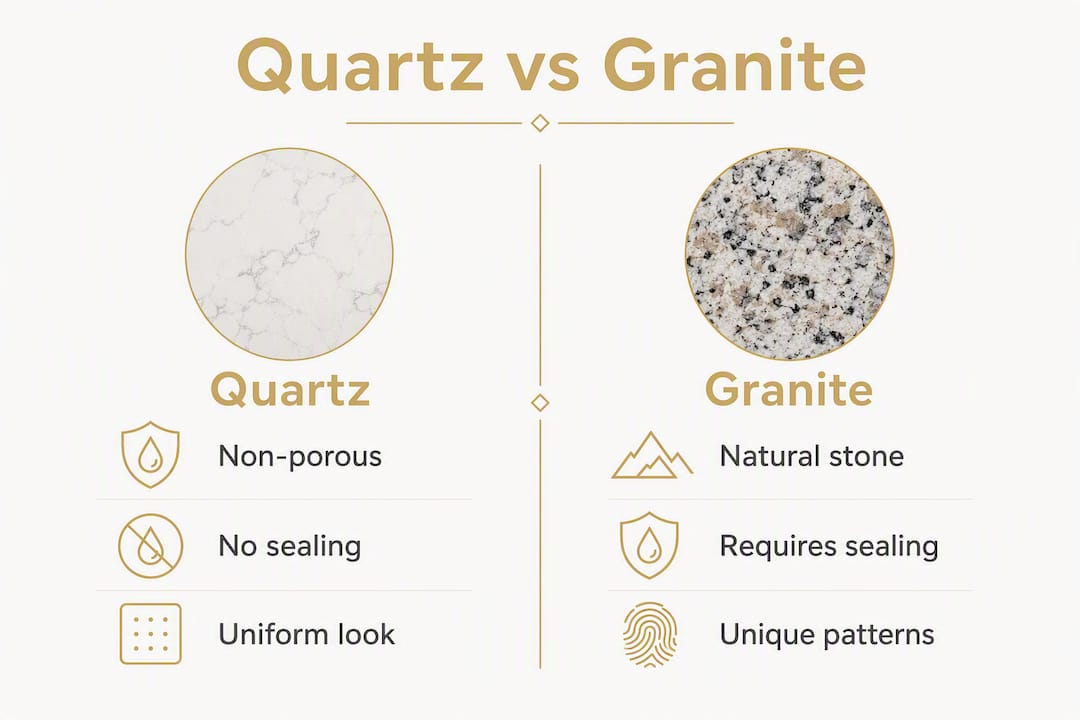
Daily care for granite follows a similar cleaning routine, but the stakes are higher if you let acidic liquids sit. Coffee, wine, citrus juice, and cooking oils can penetrate an unsealed or under-sealed granite surface and leave permanent stains. Wipe spills immediately. Use pH-neutral cleaners rather than vinegar or citrus-based products, which etch the stone over time.
Sealing granite: Most slabs need a penetrating sealer applied every 1–3 years, but the right interval depends on the specific stone’s porosity. The water-drop test above is a reliable field check. Apply sealer to a clean, dry surface, let it penetrate for the time the manufacturer specifies, then wipe off the excess. Most homeowners can do this themselves in under an hour. Some fabricators include the first sealing in their installation price; confirm this before signing.
Repairs: Both materials can be repaired, but neither is invisible after a significant chip or crack. Quartz chips are filled with color-matched epoxy, and the repair holds well structurally. The challenge is color matching, especially on solid or lightly patterned surfaces where the fill is more visible. Granite chips are also filled with epoxy, and the natural variation in the stone often makes the repair less noticeable. Deep cracks in either material usually require a professional fabricator.
Pro Tip: Ask your fabricator for the manufacturer’s care guide before installation, not after. Some quartz brands specify particular cleaners that void the warranty if you use anything else. Getting that document upfront saves a dispute later.
Price ranges, installation timelines, and what warranties actually cover
| Quartz | Granite | |
|---|---|---|
| Installed cost | $50–$150 per sq. ft. | $40–$150 per sq. ft. |
| Fabrication lead time | Generally faster; more predictable to cut | Slightly longer; natural fissures require care |
| Installation timeline | 1–2 days typical | 1–2 days typical |
| Expected lifespan | Decades | Decades |
| Warranty (typical) | 10–15 years from manufacturer; outdoor use usually excluded | Varies by fabricator; no manufacturer warranty on natural stone |
A few things worth knowing before you budget:
- The 40 sq. ft. kitchen example above is a useful planning anchor. Most standard kitchens fall in the 30–50 sq. ft. range for countertop surface.
- Quartz fabrication is generally faster and more consistent because the material lacks natural fissures. That can translate to a shorter kitchen remodel timeline when scheduling matters.
- Granite carries no manufacturer warranty because it is a natural material. Your protection comes from the fabricator’s workmanship warranty, which varies widely. Get it in writing.
- Quartz warranties from major manufacturers are typically 10–15 years and often include stain and structural coverage. Read the exclusions: UV exposure, heat damage above the rated threshold, and outdoor use are commonly excluded.
A well-chosen countertop in either material adds measurable value to a kitchen remodel. The return on a kitchen remodel depends on more than the countertop alone, but surface material is one of the first things buyers notice during a showing.
What the market data say about quartz and granite right now
Quartz and granite together account for the majority of kitchen countertop installations in the United States. Quartz holds a leading market share among all countertop materials, with granite holding a significant but smaller share. That shift happened over roughly the past decade and tracks directly with the rise of low-maintenance household priorities and open-plan kitchen design, where consistent surface patterns read better across large spans.
The practical implication for remodelers: quartz is widely stocked, fabricators are experienced with it, and lead times are generally predictable. Granite remains popular, but exotic slabs from overseas quarries can have longer lead times and higher price variability. If you are working against a move-in deadline, quartz is the lower-risk scheduling choice.
What this means for your remodel decision:
- Quartz’s popularity means more fabricators are fluent with it, which reduces installation risk.
- Granite’s natural variation makes it harder to replace a damaged section later. If a slab from a specific quarry lot is discontinued, matching it is difficult.
- Both materials hold resale appeal. Buyers recognize quality stone, and neither choice will hurt a well-executed kitchen.
Key Takeaways
Quartz is the better fit for most homeowners because of its no-seal maintenance profile and stain resistance, while granite remains the right call for high-heat cooking, outdoor kitchens, and buyers who want a genuinely unique natural slab.
| Point | Details |
|---|---|
| Heat tolerance gap | Granite handles up to ~1,200°F; quartz resin degrades around 300°F–400°F. |
| Sealing requirement | Quartz needs no sealing; granite requires sealing every 1–3 years depending on slab porosity. |
| Cost overlap at midrange | Both materials install in the $50–$150/sq. ft. range; at the entry and exotic ends, granite ranges from $40–$175/sq. ft. |
| Outdoor use | Quartz is not suitable outdoors; UV exposure degrades the resin and voids most warranties. |
| Prestigioushome guidance | Prestigioushome helps Washington and Iron County homeowners select and install the right countertop material as part of a full kitchen or bathroom remodel. |
The choice most homeowners get wrong
Most homeowners walk into a slab yard focused on color and pattern. That is understandable. But the decision that actually affects your daily life for the next 20 years is the maintenance one, and that question gets answered before you ever see a slab.
Here is the thing about the quartz vs. granite debate that most comparison articles miss: both materials commonly outlive the typical remodel cycle. You will probably renovate your kitchen again before either countertop fails. So “which lasts longer” is almost never the right question. The right question is which one fits how you actually live in your kitchen.
The homeowners who regret their countertop choice almost always made it on aesthetics alone. The person who loved the dramatic black granite slab but did not want to think about sealing. The serious cook who chose quartz because it looked cleaner, then spent years placing trivets. These are not material failures. They are lifestyle mismatches.
My honest recommendation: answer the heat question and the maintenance question first, in that order. If you cook at high heat and want to be careless about it, get granite. If you want to wipe and forget, get quartz. Everything else, including color, veining, and finish, is secondary and solvable within either category.
One more thing: always inspect the specific slab in person, in natural light. Fabricators in Washington and Iron Counties can pull samples, but a 4-inch sample does not show you how a full slab reads across a 10-foot island. Make the trip to the slab yard before you commit.
*— Jake
Prestigioushome makes the countertop decision part of a bigger picture
Picking the right countertop material is one decision inside a kitchen remodel that involves dozens of interdependent choices: cabinet layout, lighting, plumbing rough-in, and permit requirements all affect what gets installed and when. Prestigioushome handles the full scope for homeowners in Washington and Iron Counties, Utah, from initial material selection through final installation.
A consultation with Prestigioushome includes a site measure, a budget estimate, and hands-on help narrowing down slab options that fit your design and lifestyle. The team uses 3D renderings so you can see how a specific quartz or granite surface reads in your actual kitchen before anything is ordered. For homeowners who want to visit a slab yard, Prestigioushome coordinates that visit as part of the process, not as an afterthought.
View the full range of remodeling services or check service availability in your area to get started with a free consultation.
Useful sources
- Quartz vs. Granite Countertops | SlabWise: The primary source for heat tolerance figures, porosity data, and installed cost ranges used throughout this article
- Quartz Countertops: Complete Guide | SlabWise: Composition breakdown (90–95% quartz aggregate, 5–10% resin) and fabrication speed comparisons
- Natural Stone Institute: Industry standards body for natural stone fabrication and installation; referenced for granite composition guidance.
- Minerals Education Coalition: Quartz: Authoritative mineral-composition reference for quartz as a naturally occurring crystal.

