

For most Utah homeowners building a custom home, a construction-to-permanent (one-time-close) loan is the strongest starting point. It combines the build and the mortgage into a single closing, locks your rate upfront, and eliminates the cost and stress of qualifying twice. For remodels and additions, a HELOC, cash-out refinance, or FHA 203(k) renovation loan usually fits better because you already own the property.
Quick-reference by project type:
- Full custom build (new construction): Construction-to-permanent (one-time close) or VA/USDA construction loan if eligible
- Major remodel or addition: FHA 203(k), HELOC, or cash-out refinance
- Lot purchase before building: Lot loan, then construction financing
- Small renovation: HELOC or home-equity loan
Two factors decide which route works: your lender’s construction experience and your contingency budget. Skimping on either will stall your project.
Table of Contents
- What are your construction financing options?
- How do construction loans actually work?
- What do lenders actually evaluate?
- What does construction financing actually cost?
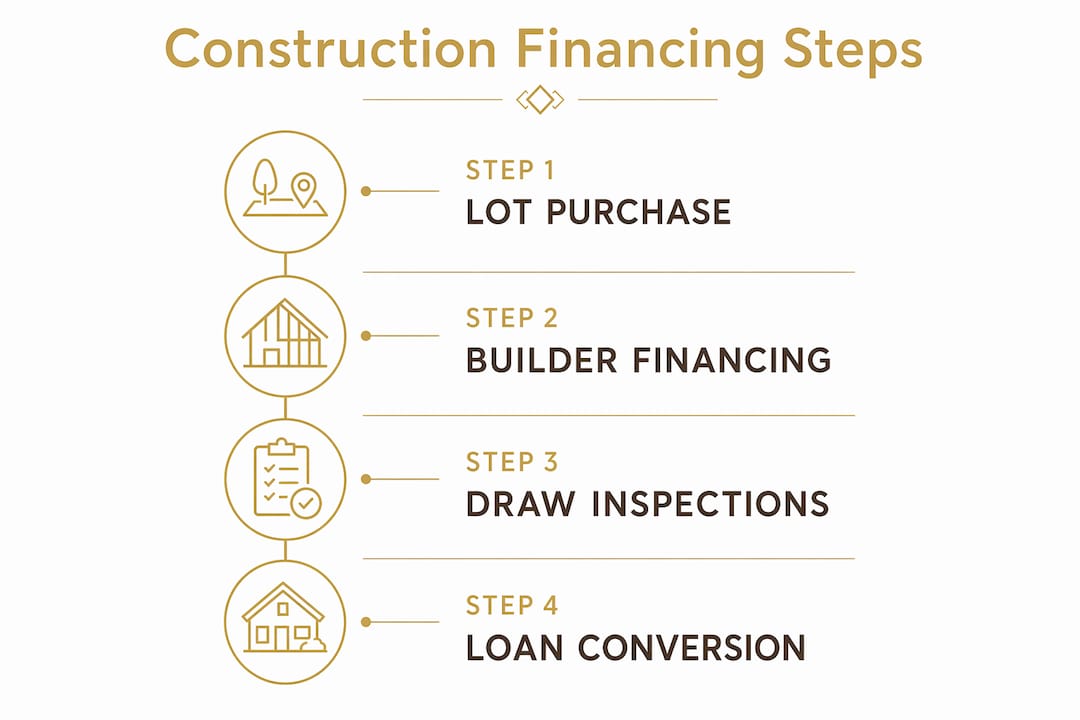
- Step-by-step: how to get construction financing in Utah
- Common financing mistakes to avoid
- How Prestigioushome reduces lender friction
- Key Takeaways
- Why builder coordination changes the financing outcome
- Ready to plan a financing-ready build in Southern Utah?
- Useful sources and where to verify program eligibility
What are your construction financing options?
Construction-to-permanent (one-time close)
This is the most popular home construction loan for custom builds. One closing covers both the construction phase and the long-term mortgage. Fannie Mae’s single-closing C-to-P product lets borrowers lock their permanent rate at the start and avoid requalifying after the build. The tradeoff: underwriting is stricter because the lender is committing to both loans at once.
- Pros: One set of closing costs, rate certainty, no second application
- Cons: Tighter credit and documentation requirements
- Best for: Full custom builds in Washington and Iron Counties
Construction-only (two-close)
A construction-only loan funds the build phase alone and must be repaid or refinanced at completion, creating two separate closings and two sets of fees. The upside is flexibility: you can shop for the best permanent mortgage terms after the build.
- Pros: Freedom to choose your permanent lender later
- Cons: Duplicate closing costs, two rounds of underwriting
- Best for: Owners confident they can secure better mortgage terms post-build
Lot loans
If you’re buying land now and building later, a lot loan bridges the gap. These carry higher rates than standard mortgages and shorter terms. Once you’re ready to build, you typically refinance into a construction loan.
FHA 203(k) and renovation loans
FHA construction-to-perm and 203(k) programs allow down payments as low as 3.5% and accommodate borrowers with lower credit scores. The 203(k) specifically funds both purchase (or refinance) and renovation costs in one loan, making it a solid fit for major remodels on an existing home.
- Best for: Buyers with limited down payment funds or lower credit scores tackling significant renovations
VA and USDA construction loans
Veterans can use their VA benefit to build with no down payment and no PMI requirement. USDA construction loans offer zero down for eligible rural properties, though income limits and geographic requirements apply. Both follow the same program rules as their standard purchase counterparts.
- Best for: Eligible veterans building in Southern Utah; rural-area buyers who qualify for USDA
HELOC, home-equity loan, and cash-out refinance
These tap existing equity and work best when you’re remodeling rather than building from scratch. A HELOC gives you a revolving credit line; a cash-out refinance replaces your existing mortgage with a larger one. Rates on these products are typically lower than construction loan rates, but you’re borrowing against your current home’s value.
- Best for: Established homeowners funding kitchen remodels, bathroom upgrades, or room additions
Builder financing and interim lines
Some builders offer staged financing or carry interim lines of credit. Evaluate these carefully: the convenience often comes with higher effective costs, and you may have less control over draw timing and lender oversight.
How do construction loans actually work?
Funds are disbursed in stages called draws, not as a lump sum. Lenders release each draw only after an independent inspector verifies that the corresponding milestone is complete. Expect four to six inspections during a typical build. During construction, you make interest-only payments on the amount drawn to date, not the full loan balance. Principal repayment begins after the loan converts to a permanent mortgage.

Sample draw schedule:
| Milestone | Typical Draw % |
|---|---|
| Site prep and foundation | 10% |
| Framing complete | 20% |
| Dry-in (roof, windows, doors) | 20% |
| Mechanicals (plumbing, electrical, HVAC) | 20% |
| Finishes and interior | 20% |
| Final completion and punch list | 5–10% |
Typical build timeline:
- Prequalification and plan finalization: 4–8 weeks
- Loan underwriting and appraisal: 4–6 weeks
- Construction phase: 9–14 months (custom builds in Southern Utah)
- Loan conversion or payoff: 2–4 weeks after certificate of occupancy
Single-close vs. two-close: With a single-close loan, you sign once and the loan automatically converts at completion. With a two-close, you close on the construction loan first, then apply for and close on a separate permanent mortgage. The second closing means a second origination fee, second title search, and second appraisal in many cases.
Pro Tip: Define each draw milestone in writing before closing. Vague milestones (“framing done”) create disputes. Specific language (“framing complete, sheathing installed, passed city framing inspection”) gives both you and your lender a clear trigger.
What do lenders actually evaluate?
Lenders assess two things simultaneously: your financial profile and your builder’s credentials. Lenders look at builder licensing, insurance, references, and past project experience as part of underwriting risk. Most lenders will not approve an owner-builder loan unless the borrower is a licensed builder by trade, so selecting a licensed general contractor is non-negotiable.
Borrower checklist:
- Two years of tax returns and W-2s (or 1099s for self-employed)
- Two to three months of bank and asset statements
- Proof of down payment funds (typically 5–20% for conventional; 3.5% for FHA)
- Credit score documentation (most conventional construction lenders prefer 680+)
- Signed purchase contract for land if applicable
Builder checklist:
- State contractor’s license (Utah Division of Occupational and Professional Licensing)
- General liability and workers’ compensation insurance certificates
- Three to five references with completed project photos
- Signed construction contract with line-item budget and draw schedule
- Project timeline tied to lender milestones
Questions to ask your lender: How long does your construction underwriting take? Who orders inspections and how quickly are draws released after approval? Do you require contingency reserves to be held in escrow?
For Utah-specific cost context, see what drives home building costs in the region before you finalize your budget with a lender.
What does construction financing actually cost?
Plan for three cost layers: lender fees, interest during construction, and a contingency reserve. Lenders commonly require a contingency fund of 10–20% of the total budget to cover overruns from supply chain volatility, labor shortages, or design changes.
Sample cost breakdown (illustrative, not a quote):
| Cost Item | Notes |
|---|---|
| Land | Varies widely by location and lot size |
| Hard construction costs | Labor and materials; largest line item |
| Soft costs | Permits, design fees, surveys, inspections |
| Lender origination fee | Typically 1–2% of loan amount |
| Closing costs | Title, appraisal, escrow; duplicated on two-close loans |
| Interest during construction | Interest-only on drawn balance; 9–14 months typical |
| Contingency reserve (10–20%) | Required by many lenders; held in escrow |
On a $500,000 construction budget, a 10% contingency adds $50,000; a 20% contingency adds $100,000. That gap matters when you’re setting your total loan amount. Two-close loans also add a second round of closing costs, which can run several thousand dollars depending on loan size and lender.
For a deeper look at where costs concentrate, the most expensive parts of building a house in Utah often surprise first-time builders.
Step-by-step: how to get construction financing in Utah
- Finalize your plans and select a licensed builder before contacting lenders. Lenders evaluate builder credentials during underwriting, so applying without a signed contract wastes time.
- Get prequalified with two or three construction-experienced lenders. Ask specifically about one-time-close products and their draw process.
- Complete your construction contract with a line-item budget, draw schedule tied to milestones, and a change-order clause.
- Submit your full loan application with borrower documents, builder credentials, plans, and budget.
- Underwriting and appraisal: the lender orders an “as-completed” appraisal based on your plans. Allow 4–6 weeks.
- Close the loan. For a one-time-close, this is your only closing. For a two-close, this is closing one.
- Manage draws during construction. Coordinate with your builder on inspection scheduling. Delays in inspection access delay draws.
- Final inspection and conversion. After the certificate of occupancy, a one-time-close loan converts automatically. A two-close requires a new mortgage application.
Utah-specific note: Washington County and Iron County each have their own permit offices and inspection schedules. Contact the Washington County Building Department or Iron County Building Department early to understand permit timelines, as delays there can affect your draw schedule and your lender’s patience.
Common financing mistakes to avoid
The most costly errors are under-budgeting for contingency, applying before plans are finalized, and choosing a lender with no construction experience.
- Insufficient contingency: Budget at least 10%, preferably 20%. Lenders often require it in writing. A change order mid-build with no reserve can halt the project.
- Weak builder documentation: Missing licenses, expired insurance, or no references can kill an approval. Collect everything before applying.
- Ignoring draw timing: If your builder can’t pass an inspection, the draw doesn’t release. Discuss inspection readiness before each milestone.
- Skipping inspection verification: Confirm that your lender uses an independent inspector, not just the builder’s self-certification.
- Underestimating two-close costs: Duplicate closing costs on a two-close loan add up. Get a full fee estimate for both closings before choosing this route.
Preventive action: require a change-order clause in your construction contract, hold contingency funds in a separate escrow account, and verify your builder’s draw schedule matches your lender’s milestone definitions before you sign anything.
How Prestigioushome reduces lender friction
Licensed builders that provide clear milestone schedules and coordinate inspections materially reduce draw delays and lender objections. Prestigioushome prepares exactly that: lender-ready documentation, detailed milestone schedules, and line-item budgets that match what construction lenders require.
Specific ways Prestigioushome supports the financing process:
- Licensed contractor documentation ready for lender submission
- 3D renderings and detailed architectural plans that support the lender’s “as-completed” appraisal
- Milestone-based draw schedules aligned to standard lender inspection triggers
- References and past-project portfolios for underwriting review
- Permit coordination with Washington County and Iron County offices, reducing timeline surprises
Virtual consultations and 3D plan reviews also give appraisers the visual documentation they need to support a strong as-completed value, which directly affects how much you can borrow. For homeowners planning a custom build, understanding the full process before your first lender conversation puts you in a much stronger position.
Key Takeaways
A one-time-close construction-to-permanent loan is the most cost-efficient building financing solution for most Utah custom home projects, but only when paired with a licensed builder, a 10–20% contingency reserve, and a lender experienced in construction underwriting.
| Point | Details |
|---|---|
| Choose the right loan type | One-time-close for new builds; HELOC or 203(k) for remodels and additions. |
| Budget a contingency | Lenders often require a reserve in the 10–20% range of your total build budget to cover overruns. |
| Builder credentials matter at underwriting | Lenders evaluate licensing, insurance, references, and past projects before approving. |
| Finalize plans before applying | Applying without a signed contract and line-item budget wastes weeks and risks denial. |
| Prestigioushome prepares lender-ready builds | Milestone schedules, 3D plans, and permit coordination in Washington and Iron Counties reduce draw delays. |
Why builder coordination changes the financing outcome
Most financing guides focus entirely on the borrower side: credit score, down payment, income documentation. That’s necessary, but it’s only half the picture. The builder’s documentation package is equally decisive, and it’s the half most homeowners don’t control until they’ve already chosen their contractor.
What I’ve seen repeatedly: projects stall not because the borrower was unqualified, but because the builder couldn’t produce a milestone schedule that matched the lender’s draw triggers, or because the “as-completed” appraisal came in low due to vague plans. A builder who has been through the construction loan process understands what lenders actually need, and that knowledge shortens the approval timeline and reduces interest costs during the build.
The practical takeaway: vet your builder’s lender experience as carefully as you vet their construction portfolio. Ask directly whether they’ve worked with construction lenders before, whether they can provide a milestone-based draw schedule, and whether they’ll coordinate with your lender’s inspector. Those three questions separate builders who will help you close from those who will slow you down.
Ready to plan a financing-ready build in Southern Utah?
Prestigioushome works with homeowners in Washington and Iron Counties from the first budget conversation through final inspection, providing the lender-ready documentation, 3D plans, and milestone schedules that construction lenders require.

A consultation covers your project scope, a preliminary budget estimate, and a draw schedule preview you can take directly to lenders. That means you walk into your first lender meeting with a complete package, not a rough idea.
Start your custom home planning or explore full home remodeling services for renovation financing projects in Southern Utah.
Useful sources and where to verify program eligibility
- Bankrate: Construction Loans Explained — draw schedules, interest-only payment mechanics, contingency guidance, and two-close trade-offs
- Fannie Mae: Construction Products — single-close and two-close C-to-P program details and eligibility
- Fairway Independent Mortgage: Construction Loans — one-time-close mechanics and builder credential requirements
- U.S. Bank: Construction Loans — draw administration and licensed builder coordination
- Andes Mortgage: Construction Loans — FHA, VA, USDA program eligibility and owner-builder restrictions
- Utah Division of Occupational and Professional Licensing (dopl.utah.gov): verify contractor licensing before signing any construction contract
- Washington County Building Department / Iron County Building Department: confirm permit timelines and inspection schedules before finalizing your construction draw schedule with a lender
This article is general information, not legal, financial, or tax advice. Verify current program eligibility, rates, and permit requirements with your lender, a licensed mortgage professional, and the relevant Utah county offices for your specific situation.

